A 500 g ball moves horizontally with velocity v𝓍 = ( 15 m) / (t + 1 s) for t > 0 s. What is the net force on the ball at t = 1 s?
Verified step by step guidance
1
Step 1: Identify the given quantities. The mass of the ball is m = 500 g = 0.5 kg (convert grams to kilograms). The velocity of the ball is given as vₓ = (15 m) / (t + 1 s). We are tasked with finding the net force on the ball at t = 1 s.
Step 2: Recall Newton's Second Law of Motion, which states that the net force on an object is given by F = m * a, where F is the net force, m is the mass, and a is the acceleration. To find the force, we first need to calculate the acceleration of the ball at t = 1 s.
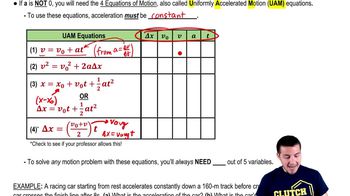
Step 3: Acceleration is the time derivative of velocity. Differentiate the velocity function vₓ = (15 m) / (t + 1 s) with respect to time t. Use the quotient rule for differentiation: d(vₓ)/dt = d/dt[(15)/(t + 1)] = -15 / (t + 1)².
Step 4: Substitute t = 1 s into the expression for acceleration to find the acceleration at that specific time. The acceleration at t = 1 s is a = -15 / (1 + 1)² = -15 / 4 m/s².
Step 5: Use the formula F = m * a to calculate the net force. Substitute m = 0.5 kg and a = -15 / 4 m/s² into the equation. The net force is F = 0.5 * (-15 / 4) N. Simplify this expression to find the magnitude and direction of the net force.
Verified video answer for a similar problem:
This video solution was recommended by our tutors as helpful for the problem above
Video duration:
6m
Play a video:
0 Comments
Key Concepts
Here are the essential concepts you must grasp in order to answer the question correctly.
Newton's Second Law of Motion
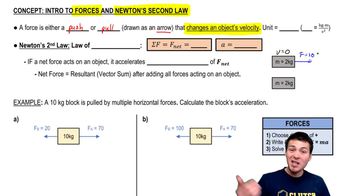
Newton's Second Law states that the net force acting on an object is equal to the mass of the object multiplied by its acceleration (F = ma). This principle is crucial for determining the net force on the ball, as it relates the force to the object's mass and how its velocity changes over time.
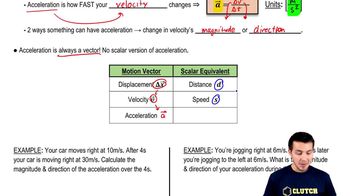
Acceleration is defined as the rate of change of velocity with respect to time. In this scenario, the velocity of the ball is given as a function of time, which means we need to differentiate this function to find the acceleration at a specific time, such as t = 1 s.
Kinematics is the branch of mechanics that describes the motion of objects without considering the forces that cause the motion. Understanding kinematics is essential here, as it allows us to analyze the ball's velocity function and derive the necessary information about its motion to calculate the net force.