A turtle crawls along a straight line, which we will call the x-axis with the positive direction to the right. The equation for the turtle's position as a function of time is x(t)=50.0 cm + (2.00 cm/s) − (0.0625 cm/s2)t2. At what time is the velocity of the turtle zero?
Verified step by step guidance
1
Start by understanding the given position function: x(t) = 50.0 cm + (2.00 cm/s)t − (0.0625 cm/s²)t². This function describes the turtle's position on the x-axis as a function of time.
To find the time when the velocity is zero, first determine the expression for velocity. Velocity is the derivative of the position function with respect to time. Differentiate x(t) to get v(t).
The derivative of x(t) = 50.0 cm + (2.00 cm/s)t − (0.0625 cm/s²)t² is v(t) = d(x)/dt = 2.00 cm/s − 2(0.0625 cm/s²)t.
Set the velocity function v(t) equal to zero to find the time when the velocity is zero: 0 = 2.00 cm/s − 2(0.0625 cm/s²)t.
Solve the equation 0 = 2.00 cm/s − 2(0.0625 cm/s²)t for t. This will give you the time at which the turtle's velocity is zero.
Verified video answer for a similar problem:
This video solution was recommended by our tutors as helpful for the problem above
Video duration:
2m
Play a video:
0 Comments
Key Concepts
Here are the essential concepts you must grasp in order to answer the question correctly.
Kinematics
Kinematics is the branch of physics that deals with the motion of objects without considering the forces that cause the motion. It involves parameters such as position, velocity, and acceleration. In this problem, the turtle's position is given as a function of time, which allows us to derive its velocity and acceleration.
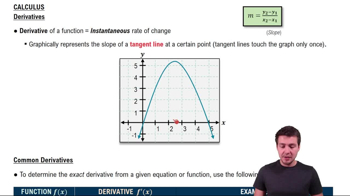
Velocity is a vector quantity that describes the rate of change of an object's position with respect to time. It is the first derivative of the position function with respect to time. For the turtle, the velocity function can be found by differentiating the given position function x(t) with respect to time t.
The derivative is a fundamental concept in calculus that measures how a function changes as its input changes. In physics, it is used to find rates of change, such as velocity and acceleration. To find when the turtle's velocity is zero, we take the derivative of the position function to get the velocity function and solve for when this derivative equals zero.