For the two vectors in Fig. E1.35, find the magnitude and direction of the vector product A x B
Verified step by step guidance
1
First, understand that the vector product, also known as the cross product, of two vectors \( \mathbf{A} \) and \( \mathbf{B} \) is given by \( \mathbf{A} \times \mathbf{B} = |\mathbf{A}| |\mathbf{B}| \sin(\theta) \mathbf{n} \), where \( \theta \) is the angle between the vectors and \( \mathbf{n} \) is a unit vector perpendicular to the plane containing \( \mathbf{A} \) and \( \mathbf{B} \).
Calculate the magnitudes of vectors \( \mathbf{A} \) and \( \mathbf{B} \) from the given lengths: \( |\mathbf{A}| = 2.80 \text{ cm} \) and \( |\mathbf{B}| = 1.90 \text{ cm} \).
Determine the angle \( \theta \) between the vectors \( \mathbf{A} \) and \( \mathbf{B} \). From the diagram, both vectors make an angle of \( 60.0^\circ \) with the x-axis, so the angle between them is \( 120.0^\circ \).
Substitute the values into the cross product formula: \( |\mathbf{A} \times \mathbf{B}| = (2.80 \text{ cm})(1.90 \text{ cm}) \sin(120.0^\circ) \). Use the fact that \( \sin(120.0^\circ) = \sin(60.0^\circ) = \frac{\sqrt{3}}{2} \).
The direction of the vector product \( \mathbf{A} \times \mathbf{B} \) is given by the right-hand rule. Point your fingers in the direction of \( \mathbf{A} \) and curl them towards \( \mathbf{B} \); your thumb will point in the direction of \( \mathbf{A} \times \mathbf{B} \), which is perpendicular to the plane containing \( \mathbf{A} \) and \( \mathbf{B} \). In this case, it will be out of the page.
Verified video answer for a similar problem:
This video solution was recommended by our tutors as helpful for the problem above
Video duration:
3m
Play a video:
0 Comments
Key Concepts
Here are the essential concepts you must grasp in order to answer the question correctly.
Vector Product (Cross Product)
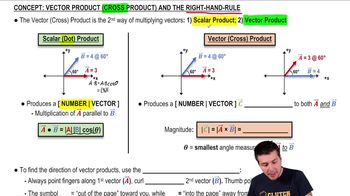
The vector product, or cross product, of two vectors A and B, denoted as A x B, results in a third vector that is perpendicular to the plane formed by A and B. The magnitude of the cross product is given by |A||B|sin(θ), where θ is the angle between the two vectors. This operation is essential in physics for determining torque, angular momentum, and the magnetic force on a charged particle.
The magnitude of a vector is a measure of its length and is calculated using the Pythagorean theorem in Cartesian coordinates. For a vector represented in two dimensions, the magnitude can be found using the formula |A| = √(Ax² + Ay²), where Ax and Ay are the vector's components along the x and y axes. Understanding the magnitude is crucial for calculating the vector product and interpreting physical quantities.
The direction of a vector indicates the orientation of the vector in space and is often expressed in terms of angles relative to a reference axis. In the context of the vector product, the direction of the resulting vector A x B is determined by the right-hand rule, which states that if the fingers of the right hand curl from vector A to vector B, the thumb points in the direction of A x B. This concept is vital for visualizing and solving problems involving vector interactions.

 3:22 minutes
 Verified step by step guidance
 10:30
10:30