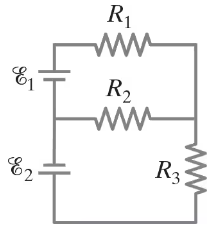
(II) Determine the magnitudes and directions of the currents in each resistor shown in Fig. 26–57. The batteries have emfs of ε1 = 9.0V and ε2 = 12.0V and the resistors have values of R1 = 25 Ω, R2 = 48 Ω, and R3 = 35 Ω. (a) Ignore internal resistance of the batteries. (b) Assume each battery has internal resistance r = 1.0 Ω.
Verified step by step guidance
1
Step 1: Identify the circuit configuration and label the currents. Analyze the circuit to determine if it is a series, parallel, or a combination circuit. Assign current variables (e.g., I₁, I₂, I₃) to each branch of the circuit and define their directions (assume directions initially; corrections can be made later if needed).
Step 2: Apply Kirchhoff's Voltage Law (KVL) to each loop in the circuit. For each loop, write an equation summing the voltage drops across resistors and batteries, ensuring to account for the polarity of the batteries and the assumed current directions. For example, for a loop containing a resistor R and a battery ε, the voltage drop is given by V = IR, and the battery contributes ε (positive or negative depending on direction).
Step 3: Apply Kirchhoff's Current Law (KCL) at any junctions in the circuit. This law states that the sum of currents entering a junction equals the sum of currents leaving the junction. Write equations based on this principle to relate the currents in different branches.
Step 4: Solve the system of equations obtained from KVL and KCL. Use algebraic methods (e.g., substitution or matrix methods) to solve for the unknown currents (I₁, I₂, I₃). Ensure to include the internal resistance of the batteries (r = 1.0 Ω) in part (b) by adding the term rI to the voltage drop across each battery.
Step 5: Determine the magnitudes and directions of the currents. If any current value is negative, it means the actual direction of the current is opposite to the initially assumed direction. Interpret the results and verify that they satisfy all the equations and physical constraints of the circuit.
Verified video answer for a similar problem:
This video solution was recommended by our tutors as helpful for the problem above
Video duration:
10m
Play a video:
0 Comments
Key Concepts
Here are the essential concepts you must grasp in order to answer the question correctly.
Ohm's Law
Ohm's Law states that the current (I) flowing through a conductor between two points is directly proportional to the voltage (V) across the two points and inversely proportional to the resistance (R) of the conductor. This relationship is expressed mathematically as V = IR. Understanding this law is essential for analyzing circuits, as it allows us to calculate the current through each resistor when the voltage and resistance values are known.
Kirchhoff's Laws
Kirchhoff's Laws consist of two principles that govern the behavior of electrical circuits. Kirchhoff's Current Law (KCL) states that the total current entering a junction must equal the total current leaving the junction, while Kirchhoff's Voltage Law (KVL) states that the sum of the electrical potential differences (voltage) around any closed circuit loop must equal zero. These laws are fundamental for analyzing complex circuits with multiple components.
Series and Parallel Circuits
In electrical circuits, components can be arranged in series or parallel configurations. In a series circuit, the same current flows through all components, and the total resistance is the sum of individual resistances. In a parallel circuit, the voltage across each component is the same, and the total current is the sum of the currents through each branch. Understanding these configurations is crucial for determining how current flows and how to calculate equivalent resistances in the given circuit.