What is it called when your tires ride on a thin film of water during heavy rain?
This phenomenon is called hydroplaning.
What happens when a thin glass rod is submerged in oil?
The rod experiences a buoyant force equal to the weight of the oil displaced by its submerged volume.
Why does the buoyant force act upward on a submerged object?
The buoyant force acts upward because the pressure at the bottom of the object is greater than at the top, resulting in a net upward force.
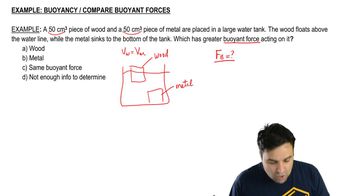
What is true about a barge floating in fresh water?
A barge floats because the weight of the water it displaces equals its own weight.
What happens to the buoyant force on a coin as it sinks in a lake?
The buoyant force on the coin remains constant as it sinks, as long as it is fully submerged.
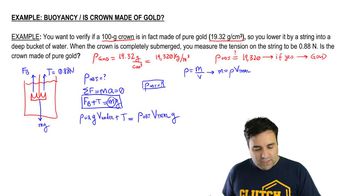
What two variables must you use to calculate the buoyant force on a submerged object using the formula FB = ρ_liquid × g × V_under?
You must use the density of the liquid and the volume of the object that is submerged. The object's own density is not used in this formula.
In a force diagram for a floating object, which two forces are always present and in which directions do they act?
The buoyant force acts upward and the gravitational force (mg) acts downward. These forces are equal in magnitude when the object is at equilibrium.
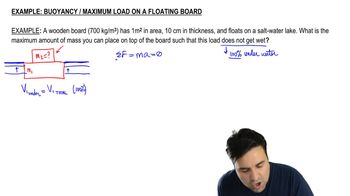
How does the percentage of an object's volume submerged relate to its density compared to the liquid's density?
The percentage of the object's volume submerged equals the ratio of the object's density to the liquid's density. This relationship only holds for floating objects.
What happens to the normal force (scale reading) when a dense block is fully submerged and resting on the bottom of a tank?
The normal force equals the object's weight minus the buoyant force. This is because the buoyant force partially offsets the object's weight.
Why do the side forces from liquid pressure on a submerged object not contribute to the buoyant force?
The side forces are equal and opposite, so they cancel each other out. Only the difference between the upward force at the bottom and the downward force at the top creates the net buoyant force.
 Back
Back

 06:55
06:55