The Carnot Cycle definitions Flashcards
The Carnot Cycle definitions
You can tap to flip the card.
Control buttons has been changed to "navigation" mode.
1/15
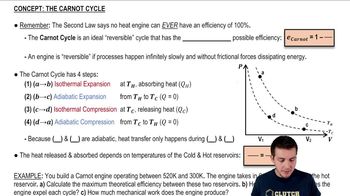
Carnot CycleAn ideal reversible cycle with maximum efficiency, consisting of two isothermal and two adiabatic processes.ReversibleA process occurring infinitely slowly with no friction, allowing the system to return to its initial state.Isothermal ExpansionA process where a system absorbs heat from a hot reservoir while maintaining constant temperature.Adiabatic ExpansionA process where a system expands without heat transfer, resulting in a temperature decrease.Isothermal CompressionA process where a system releases heat to a cold reservoir while maintaining constant temperature.Adiabatic CompressionA process where a system compresses without heat transfer, resulting in a temperature increase.Maximum Theoretical EfficiencyThe highest efficiency achievable by a heat engine, calculated as 1 - (Tc/Th).Hot ReservoirThe source from which a heat engine absorbs heat during the isothermal expansion phase.Cold ReservoirThe sink to which a heat engine releases heat during the isothermal compression phase.Waste HeatThe heat expelled to the cold reservoir, calculated using the ratio of reservoir temperatures.Mechanical WorkThe energy output of a heat engine, equal to the difference between absorbed and expelled heat.Efficiency EquationAn equation relating the efficiency of a Carnot engine to the temperatures of the reservoirs.Heat TransferThe process of heat energy moving between the system and reservoirs during isothermal processes.ThermodynamicsThe branch of physics dealing with heat, work, and energy transformations.Reservoir TemperaturesThe temperatures of the hot and cold reservoirs, crucial for determining engine efficiency.