Skip to main content
Physics
My Course
Learn
Exam Prep
AI Tutor
Study Guides
Textbook Solutions
Flashcards
Explore
Try the app
My Course
Learn
Exam Prep
AI Tutor
Study Guides
Textbook Solutions
Flashcards
Explore
Try the app
Back
Consequences of Relativity definitions
You can tap to flip the card.
Time Dilation
You can tap to flip the card.
👆
Time Dilation
Phenomenon where time appears to stretch in a moving frame compared to a stationary frame due to the constant speed of light.
Track progress
Control buttons has been changed to "navigation" mode.
1/15
Related flashcards
Related practice
Recommended videos
Consequences of Relativity quiz
Consequences of Relativity
15 Terms
Consequences of Relativity
35. Special Relativity
3 problems
Topic
Patrick
Lorentz Transformations
35. Special Relativity
5 problems
Topic
Emilee
35. Special Relativity
4 topics
10 problems
Chapter
Patrick
Guided course
07:49
Proper Frames and Measurements
1870
views
17
rank
2
comments
Guided course
07:37
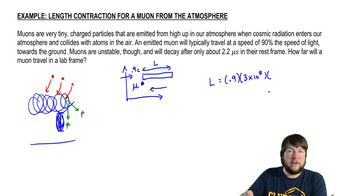
Length Contraction for a Muon from the Atmosphere
1806
views
9
rank
3
comments
Guided course
04:32
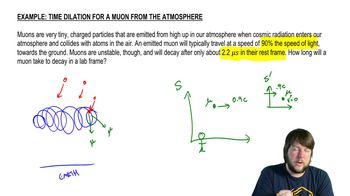
Time Dilation for a Muon from the Atmosphere
2364
views
20
rank
3
comments
Terms in this set (15)
Hide definitions
Time Dilation
Phenomenon where time appears to stretch in a moving frame compared to a stationary frame due to the constant speed of light.
Length Contraction
Objects in motion appear shorter in the direction of motion compared to when they are at rest.
Proper Frame
A reference frame at rest relative to the object or event being measured.
Non-Proper Frame
A reference frame in which the object or event is in motion.
Lorentz Factor
A factor, gamma, that quantifies time dilation and length contraction, calculated as 1/sqrt(1-u^2/c^2).
Proper Time
Time interval measured in the frame where the event occurs at rest.
Dilated Time
Time interval measured in a frame where the event is in motion, longer than proper time.
Proper Length
Length of an object measured in the frame where the object is at rest.
Contracted Length
Length of an object measured in a frame where the object is in motion, shorter than proper length.
Escape Velocity
Minimum speed needed for an object to break free from a planet's gravitational pull without further propulsion.
Inertial Frame
A reference frame in which an object not subject to forces moves at a constant velocity.
Speed of Light
Constant speed at which light travels in a vacuum, approximately 299,792,458 meters per second.
Thought Experiment
A hypothetical scenario used to illustrate and reason about complex concepts, often used in physics.
Reference Frame
A coordinate system or viewpoint used to measure and observe physical phenomena.
Special Relativity
Einstein's theory describing the physics of objects moving at constant speeds, particularly near the speed of light.
 BackBack

 07:49
07:49