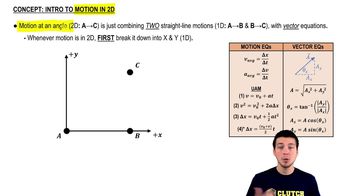
When is position described using two dimensions in physics?
Position is described using two dimensions when an object moves in a plane, meaning its location is specified by both X and Y coordinates, rather than just along a single axis.
What determines the direction of motion for an object, such as a boy on a skateboard, in two-dimensional motion?
The direction of motion for an object in two-dimensional motion is determined by the vector sum of its velocity components along the X and Y axes, which can be represented as a vector at an angle.
What is a simple model that can help you understand the forces or motion acting on an object in two dimensions?
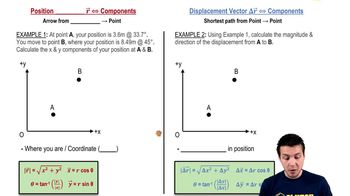
A simple model is to represent the object's position and displacement as vectors, which can be broken down into X and Y components using trigonometric functions, forming a right triangle.
How do you determine the total angle through which a wheel turns between two times if you know its angular displacement?
The total angle through which a wheel turns is equal to its angular displacement, which can be calculated as the difference in its angular position between the two times.
How can you determine the number of complete revolutions a bicycle wheel makes when you ride a certain distance?
The number of complete revolutions is found by dividing the total distance traveled by the circumference of the wheel: Number of revolutions = (distance traveled) / (wheel circumference).
Which coordinates describing position are dependent on the location of the observer in two-dimensional motion?
The X and Y coordinates of an object's position are dependent on the observer's chosen origin or reference point.
Compared to moving in a straight line, what does swerving in a curve require more of in terms of motion in two dimensions?
Swerving in a curve requires more change in direction, which involves a greater change in the velocity vector and thus a greater displacement in two dimensions.
How can you describe the motion of a boat traveling east across a river using two-dimensional motion concepts?
The boat's motion can be described as a vector with components: one in the east (X) direction due to the boat's velocity, and one in the north or south (Y) direction due to the river's current, resulting in a net displacement at an angle.
How can you estimate the distance a driver travels if they look away from the road for one second while moving at a constant speed?
The distance traveled is the product of speed and time: distance = speed × time.
How can you describe the position of a drone flying at a constant height using two-dimensional motion concepts?
The drone's position can be described by its X and Y coordinates in the horizontal plane, forming a position vector from the origin to its current location.
Ignoring friction and air resistance, how do you determine the speed of an object after a certain time if it starts from rest and accelerates uniformly?
The speed after time t is given by v = a × t, where a is the constant acceleration and t is the elapsed time.
How do you find the distance traveled by a car between two times in two-dimensional motion?
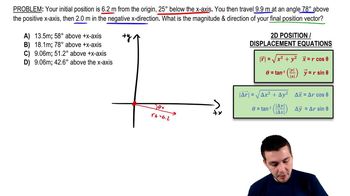
The distance traveled is the magnitude of the displacement vector between the two positions, calculated using the Pythagorean theorem: distance = sqrt[(Δx)^2 + (Δy)^2], where Δx and Δy are the changes in X and Y coordinates.
How do you determine the position of three particles fixed on an x-axis using two-dimensional motion concepts?
Each particle's position is specified by its X coordinate along the x-axis, and since they are fixed on the x-axis, their Y coordinates are zero.
How is a two-dimensional tug of war analyzed using vectors?
A two-dimensional tug of war is analyzed by representing each force as a vector with X and Y components, then summing the vectors to find the net force and its direction.
 Back
Back

 07:07
07:07