Electric Charge quiz #1 Flashcards

Electric Charge quiz #1
Control buttons has been changed to "navigation" mode.
1/40
  • Why do electrons move from the negative end of a tube to the positive end?

    Electrons move from the negative end to the positive end because they are negatively charged and are attracted to the positive charge, following the electric force.
  • What can you conclude from the deflection of a cathode ray in a magnetic field?

    The deflection of a cathode ray in a magnetic field indicates that the ray consists of charged particles, specifically electrons.
  • What is the electrical charge of a neutron?

    A neutron has zero electrical charge; it is electrically neutral.
  • What is the difference between a conductor and an insulator in terms of electrons?

    A conductor allows electrons to move freely, while an insulator restricts the movement of electrons.
  • Why do metals often make good conductors?

    Metals make good conductors because they have free electrons that can move easily throughout the material.
  • What is the unit used to measure electric current?

    The unit used to measure electric current is the ampere (A).
  • Which force results from charged particles?

    The electric force results from charged particles.
  • What charge holds small particles together in space?

    Electric charge can hold small particles together through electric forces if they are oppositely charged.
  • In a circuit diagram, what does the symbol for electric charge represent?

    In a circuit diagram, the symbol for electric charge represents the flow of electrons or current through the circuit.
  • Which unit is used to measure resistance?

    The unit used to measure resistance is the ohm (Ω).
  • What is the main disadvantage of parallel circuits?

    A main disadvantage of parallel circuits is that if one branch fails, the others can still operate, which may lead to excessive current and potential hazards.
  • How do the charges compare when two objects are charged through friction?

    When two objects are charged through friction, one becomes positively charged and the other negatively charged, with equal magnitude but opposite sign.
  • Is it true or false that electricity cannot flow through the air?

    It is generally true that electricity cannot flow through air under normal conditions, but it can flow if the air is ionized, such as during lightning.
  • What is the function of the slip rings in an electric generator?

    Slip rings in an electric generator allow the coil to rotate freely while maintaining electrical contact, enabling the generation of alternating current.
  • Which device measures the resistance of electrical current?

    An ohmmeter measures the resistance of electrical current.
  • How does an object become negatively charged?

    An object becomes negatively charged by gaining extra electrons.
  • Does a battery produce direct current (DC) or alternating current (AC)? Does a generator at a commercial power station produce DC or AC?

    A battery produces direct current (DC), while a generator at a commercial power station typically produces alternating current (AC).
  • What happens when a charged insulator is placed near an uncharged metallic object?

    When a charged insulator is placed near an uncharged metallic object, it can induce a rearrangement of charges in the metallic object, causing polarization.
  • Alternators induce voltage by rotating which component?

    Alternators induce voltage by rotating a coil within a magnetic field.
  • How is the net electric force on a charge determined?

    The net electric force on a charge is determined by the vector sum of all electric forces acting on it from other charges.
  • What bias has been applied to a pn junction if the cathode is positive with respect to the anode?

    If the cathode is positive with respect to the anode, the pn junction is reverse biased.
  • What is the term for the basic unit of electric current?

    The basic unit of electric current is the ampere (A).
  • What is the unit of measurement for electric current?

    The unit of measurement for electric current is the ampere (A).
  • What is the rearranging of charge that results in one side being positive and the other negative called?

    The rearranging of charge that results in one side being positive and the other negative is called polarization.
  • Where is electric charge located in an atom?

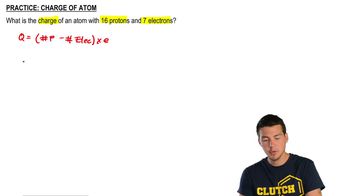
    Electric charge in an atom is located in the protons (positive) in the nucleus and electrons (negative) orbiting the nucleus.
  • What is the term for the basic unit of electric current?

    The basic unit of electric current is the ampere (A).
  • An electric current is defined as the flow of what through a conductor?

    An electric current is defined as the flow of electric charge, typically electrons, through a conductor.
  • What is the advantage of a circuit breaker compared to a fuse?

    A circuit breaker can be reset and reused after tripping, while a fuse must be replaced after it blows.
  • How is a charged object able to move other objects from a distance?

    A charged object can move other objects from a distance by exerting an electric force, which acts at a distance.
  • What is the unit of measure of electric current flow?

    The unit of measure of electric current flow is the ampere (A).
  • What must be true for a circuit to light a bulb?

    For a circuit to light a bulb, it must be a closed loop allowing electric current to flow through the bulb.
  • What is the difference between an open and a closed circuit?

    An open circuit has a break preventing current flow, while a closed circuit forms a complete path allowing current to flow.
  • Which type of force results from charged particles?

    The electric force results from charged particles.
  • How is the charge on a sphere related to its voltage and radius?

    The charge on a sphere can be calculated using the formula Q = C × V, where C is the capacitance and V is the voltage.
  • Why does a balloon stick to the wall after being rubbed?

    A balloon sticks to the wall because rubbing transfers electrons, giving it a charge that induces opposite charges on the wall, causing attraction.
  • How does one coulomb of charge compare with the charge of a single electron?

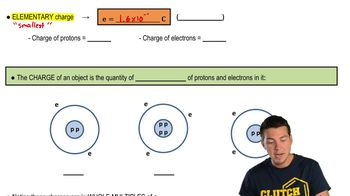
    One coulomb of charge is equal to approximately 6.25 × 10^18 times the charge of a single electron.
  • Which change increases the electric force between objects?

    Increasing the amount of charge or decreasing the distance between objects increases the electric force between them.
  • What type of particles flow between objects when they are charged by friction or conduction?

    Electrons flow between objects when they are charged by friction or conduction.
  • What is required for an electric charge to flow through a wire?

    A potential difference (voltage) is required for electric charge to flow through a wire.
  • How is the magnitude of the electric force on a mass determined?

    The magnitude of the electric force on a mass is determined by the product of the charge and the electric field acting on it.