Control buttons has been changed to "navigation" mode.
1/40
Terms in this set (40)
What is the primary purpose of a lightning rod?
The primary purpose of a lightning rod is to safely direct electric charge from lightning to the ground.
What is the negative charge if the electric field at a point is zero?
If the electric field at a point is zero, the negative charge present must exactly balance the positive charges nearby.
Through which element would someone most likely receive a shock?
Someone would most likely receive a shock through a conductor, such as a metal wire.
What is used in an electrical circuit to prevent a short circuit?
A fuse or circuit breaker is used in an electrical circuit to prevent a short circuit.
What factors determine the amount of voltage produced by a cell?
The amount of voltage produced by a cell is determined by the materials used and the chemical reactions inside the cell.
When measuring voltage using a voltmeter, how should it be connected?
A voltmeter should be connected in parallel with the component across which the voltage is to be measured.
Which materials are efficient charge carriers (conductors)?
Metals are efficient charge carriers (conductors) because they have free electrons.
Is 1/4 of the maximum current possible in a circuit under certain conditions?
The current in a circuit can be a fraction of the maximum possible, depending on resistance and voltage.
What units are used to measure the electrical resistance of a circuit?
Electrical resistance is measured in ohms (Ω).
What is a closed loop of conductors through which charges flow called?
A closed loop of conductors through which charges flow is called an electric circuit.
What does a galvanometer measure?
A galvanometer measures electric current.
How many coulombs of charge are in one ampere-hour?
One ampere-hour is equal to 3600 coulombs.
How is the magnitude of the force on a 8.0 nC charge determined?
The magnitude of the force on a 8.0 nC charge is determined by multiplying the charge by the electric field at its location.
What is the total surface charge on the exterior surface of a conductor?
The total surface charge on the exterior surface of a conductor equals the net charge placed on the conductor.
Why is it possible for a bird to sit on a high-voltage wire without being electrocuted?
A bird can sit on a high-voltage wire without being electrocuted because there is no potential difference across its body, so no current flows through it.
Electrical current can produce which type of force?
Electrical current can produce electric and magnetic forces.
Can a wire carry a current and still be neutral?
Yes, a wire can carry a current and still be electrically neutral overall.
If electrons in a wire move from point A to point B, what is the direction of the conventional current?
The direction of conventional current is from point B to point A, opposite to the flow of electrons.
What is an example of an electric force acting at a distance?
A charged balloon attracting small pieces of paper is an example of electric force acting at a distance.
Why is charge usually transferred by electrons rather than by protons?
Charge is usually transferred by electrons because they are located on the outside of atoms and can move more easily than protons, which are bound in the nucleus.
What flows through a circuit?
Electric charge, typically in the form of electrons, flows through a circuit.
How can birds sit on a power line and not get electrocuted?
Birds do not get electrocuted on power lines because there is no significant potential difference across their bodies.
What are two factors that affect the magnitude of electrical force between two charged objects?
The magnitude of electrical force depends on the amount of charge and the distance between the objects.
Current is measured in which unit?
Current is measured in amperes (A).
If object A has a charge of +2 μC, what does this mean?
Object A has a net positive charge equal to 2 microcoulombs, indicating an excess of protons over electrons.
Which condition results in the buildup of static charge on an object?
Friction between two materials can result in the buildup of static charge on an object.
If a material does not allow charges to move through it easily, what is it called?
A material that does not allow charges to move through it easily is called an insulator.
If you transfer some electrons to a metal ball, what happens to its charge?
The metal ball becomes negatively charged due to the excess electrons.
Why does static electricity move from you to a metal object after you have walked over new carpet?
Walking over carpet can transfer electrons to your body, and touching a metal object allows the excess charge to flow, causing a static shock.
Rubbing a balloon on your hair to give it a charge is an example of which method of charging?
Rubbing a balloon on your hair charges it by friction.
What electrical device allows current to flow in only one direction?
A diode allows current to flow in only one direction.
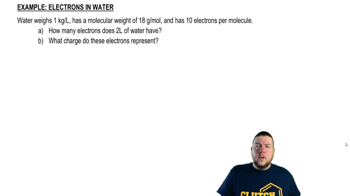
How many electrons per second flow through a wire with a 10.0 A current?
The number of electrons per second is (10.0 C/s) / (1.6 × 10^-19 C/electron) ≈ 6.25 × 10^19 electrons per second.
How is the magnitude of the force on a 5.0 nC charge determined?
The magnitude of the force on a 5.0 nC charge is found by multiplying the charge by the electric field at its location.
Which pair of objects will repel each other?
Two objects with like charges (both positive or both negative) will repel each other.
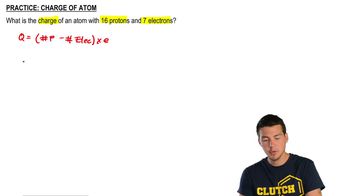
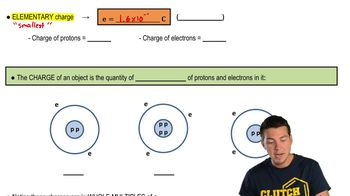
An object has 4 positive charges and 2 negative charges. What is its total charge?
The total charge is (4 - 2) × e = 2e, where e is the elementary charge.
How will two negative charges interact when they are brought close together?
Two negative charges will repel each other.
How are magnetic poles and electrical charges similar?
Magnetic poles and electrical charges both come in pairs and can attract or repel each other.
An electromagnet can be made by wrapping wire around which object?
An electromagnet can be made by wrapping wire around a ferromagnetic core, such as iron.
How many volts of electricity flow through a Van de Graaff generator?
A Van de Graaff generator can produce voltages ranging from thousands to millions of volts.
What is the transfer of electric charge between two objects that are not touching called?
The transfer of electric charge between two objects that are not touching is called induction.