If the electric field in a region of space has components Ey = Ez = 0, what is the direction of the field?
The electric field points along the x-axis.
What is the direction of the electric field produced by a negative point charge?
The electric field produced by a negative point charge points radially inward toward the charge.
What is the relationship between electric field and electric force?
The electric force on a charge q in an electric field E is F = qE.
What is the direction of the electric field at a point near a positive charge?
The electric field points away from a positive charge.
What is the direction of the electric field at a point near a negative charge?
The electric field points toward a negative charge.
What is the effect of increasing the distance from a point charge on the electric field strength?
Increasing the distance from a point charge decreases the electric field strength by the square of the distance.
What is the electric field at a point due to multiple point charges?
The electric field at a point due to multiple charges is the vector sum of the fields from each charge.
What is the convention for the direction of electric field lines?
Electric field lines are drawn from positive charges to negative charges.
What is the purpose of a ground connection in electrical systems?
A ground connection provides a safe path for excess charge to flow into the earth, preventing electric shock.
What is the electric field strength between two parallel plates with potential difference V and separation d?
The electric field strength is E = V/d.
What is the effect of the sign of a test charge on the direction of the force it experiences in an electric field?
A positive test charge experiences a force in the direction of the electric field, while a negative charge experiences a force opposite to the field.
What is the relationship between electric field strength and force on a test charge?
The force on a test charge q in an electric field E is F = qE.
What is the electric field at a point outside a uniformly charged spherical shell?
The electric field outside a uniformly charged spherical shell is E = kQ/r^2, as if all the charge were concentrated at the center.
What is the electric field at a point inside a uniformly charged spherical shell?
The electric field inside a uniformly charged spherical shell is zero.
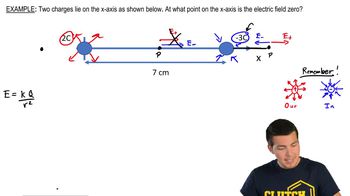
What is the direction of the electric field at a point midway between two equal positive charges?
The electric field at the midpoint between two equal positive charges points away from both charges, resulting in zero net field at the midpoint.
What is the effect of superposition on electric fields?
The net electric field at a point is the vector sum of the electric fields from all charges present.
What is the electric field at a point due to a dipole?
The electric field due to a dipole depends on the position relative to the dipole and decreases with distance faster than for a single charge.
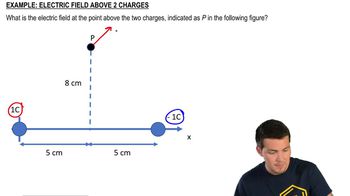
What is the direction of the electric field at a point above a positive charge?
The electric field at a point above a positive charge points directly away from the charge.
What is the electric field at a point on the axis of a ring of charge?
The electric field at a point on the axis of a ring of charge can be calculated using integration, but it points along the axis.
What is the electric field at the center of a uniformly charged ring?
The electric field at the center of a uniformly charged ring is zero due to symmetry.
What is the electric field at a point on the perpendicular bisector of a dipole?
The electric field at a point on the perpendicular bisector of a dipole is directed opposite to the dipole moment and decreases with the cube of the distance.
What is the effect of a conductor on the electric field inside it under electrostatic conditions?
The electric field inside a conductor is zero under electrostatic conditions.
What is the electric field just outside the surface of a charged conductor?
The electric field just outside the surface of a charged conductor is perpendicular to the surface and proportional to the surface charge density.
What is the electric field at a point due to a continuous charge distribution?
The electric field due to a continuous charge distribution is found by integrating the contributions from each infinitesimal charge element.
What is the effect of grounding a conductor?
Grounding a conductor allows excess charge to flow to or from the earth, neutralizing the conductor.
What is the electric field at a point due to a uniformly charged infinite plane?
The electric field due to a uniformly charged infinite plane is constant and given by E = σ/(2ε₀), where σ is the surface charge density.
What is the electric field at a point due to a uniformly charged rod?
The electric field due to a uniformly charged rod can be calculated by integrating the contributions from each segment of the rod.
What is the electric field at a point due to a uniformly charged disk?
The electric field due to a uniformly charged disk can be calculated by integrating over the disk's surface.
What is the electric field at a point due to a uniformly charged sphere?
Outside the sphere, the field is E = kQ/r^2; inside, it depends on the charge distribution.
What is the electric field at a point due to a line of charge?
The electric field due to a line of charge is found by integrating the contributions from each infinitesimal segment.
What is the electric field at a point due to a surface charge?
The electric field due to a surface charge is calculated by integrating the contributions from each surface element.
What is the electric field at a point due to a volume charge distribution?
The electric field due to a volume charge distribution is found by integrating the contributions from each volume element.
How is the direction of an electric field defined with respect to the type of charge producing it?
The direction of an electric field is defined by the type of charge producing it: it points radially outward from positive charges and radially inward toward negative charges, following a convention established centuries ago.
In which direction does the electric field point for positive and negative charges?
The electric field points outward from positive charges and inward toward negative charges.
 Back
Back

 05:23
05:23