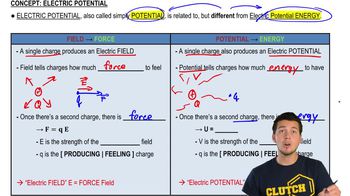
What is the standard unit of measurement for electric potential energy?
The standard unit of measurement for electric potential energy is the joule (J).
What does voltage describe in an electric circuit?
Voltage describes the potential difference between two points in an electric circuit, indicating how much energy per unit charge is available to move charges between those points.
What is the potential difference across a resistor in a circuit?
The potential difference across a resistor in a circuit is the voltage drop, which can be calculated as the difference in electric potential between the two ends of the resistor.
What is the unit of electrical resistance?
The unit of electrical resistance is the ohm (Ω).
At what position is the electric potential zero in the field of a point charge?
The electric potential is zero at a point infinitely far from a point charge, since V = kQ/r and V approaches zero as r approaches infinity.
What force pushes electrons through a resistance in a circuit?
The electric field, created by a potential difference (voltage), pushes electrons through a resistance in a circuit.
Which term is also known as electrical potential?
Voltage is also known as electrical potential or electric potential difference.
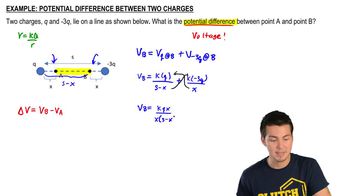
How do you calculate the potential difference between two points, a and b?
The potential difference between two points, a and b, is calculated as ΔV = Vb - Va.
What is voltage a measure of?
Voltage is a measure of the electric potential difference between two points, representing the energy per unit charge available to move charges.
What are the units of electric potential difference?
The units of electric potential difference are volts (V), where 1 volt = 1 joule per coulomb.
Which instrument is used to measure the voltage of a battery?
A voltmeter is used to measure the voltage of a battery.
What is the amplitude of the voltage across a resistor in an AC circuit?
The amplitude of the voltage across a resistor in an AC circuit is the maximum value of the voltage, often denoted as the peak voltage.
When a proton moves in an electric field, does it move into a region of higher or lower potential if it gains potential energy?
A proton moves into a region of higher potential if it gains potential energy.
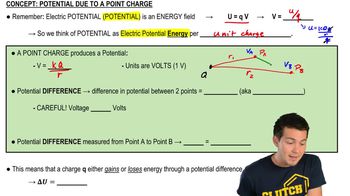
How do you calculate the electric potential at a point due to a point charge?
The electric potential at a point due to a point charge is given by V = kQ/r, where k is Coulomb's constant, Q is the charge, and r is the distance from the charge to the point.
How do you find the voltage at the midpoint between two point charges?
The voltage at the midpoint between two point charges is the algebraic sum of the potentials due to each charge at that point, using V = kQ/r for each charge.
When an electron moves in an electric field, does it move into a region of higher or lower potential if it gains potential energy?
An electron moves into a region of lower potential if it gains potential energy, since it has a negative charge.
How do you determine the electric potential at a point due to a point charge?
The electric potential at a point due to a point charge is calculated using V = kQ/r.
What is the amount of voltage available to move electrons through a circuit called?
The amount of voltage available to move electrons through a circuit is called the electromotive force (emf) or potential difference.
At what distance from a point charge is the electric potential due to that charge zero?
The electric potential due to a point charge is zero at an infinite distance from the charge.
At what point or points on the y-axis is the electric potential zero for a system of charges?
The electric potential is zero at points where the algebraic sum of the potentials from all charges equals zero, which depends on the configuration and values of the charges.
What equation would you use to solve for voltage in terms of energy and charge?
The equation to solve for voltage is V = U/Q, where U is electric potential energy and Q is charge.
How is the reading of a voltmeter in a circuit related to the potential difference it measures?
A voltmeter reads the potential difference (voltage) between the two points to which it is connected in a circuit.
Which device is used to measure voltage in a circuit?
A voltmeter is used to measure voltage in a circuit.
How do you calculate the potential difference between two points, such as points b and c?
The potential difference between two points, such as b and c, is ΔV = Vc - Vb.
How do you determine the potential difference between two points, a and b?
The potential difference between points a and b is ΔV = Vb - Va.
How do you find the magnitude of the potential difference between the ends of a rod in an electric field?
The magnitude of the potential difference between the ends of a rod in an electric field is the absolute value of the difference in electric potential between those two points.
How do you calculate the electric potential at a specific point, such as point b, due to a point charge?
The electric potential at point b due to a point charge is V = kQ/r, where r is the distance from the charge to point b.
What is the electromotive force (emf) in a circuit?
The electromotive force (emf) is the maximum potential difference provided by a source, such as a battery, to move charges through a circuit.
How is the voltage of a battery in a circuit defined?
The voltage of a battery in a circuit is the potential difference between its terminals when no current is flowing (its emf).
How do you calculate the electric potential at a point indicated by a dot near a point charge?
The electric potential at a point indicated by a dot near a point charge is V = kQ/r, where r is the distance from the charge to the dot.
How do you express the reading of a voltmeter in terms of the emf (E) of a battery?
The reading of a voltmeter connected across the terminals of a battery is equal to the emf (E) if there is no current, or less than E if there is internal resistance and current flows.
What is considered high-voltage in terms of potential difference?
High-voltage is generally defined as a potential difference of more than 1000 volts (V), though the exact threshold can vary by context.
What does it mean to measure the voltage in a circuit?
To measure the voltage in a circuit means to determine the potential difference between two points using a voltmeter.
How does a voltmeter reading close to zero indicate the potential difference between two points?
A voltmeter reading close to zero indicates that the two points it is connected to are at nearly the same electric potential.
How do you calculate the peak voltage of an AC voltage given its RMS value?
The peak voltage (V_peak) of an AC voltage is V_peak = √2 × V_rms.
How do you express the reading of a voltmeter in terms of the emf (E) of a battery?
The reading of a voltmeter across a battery is equal to the emf (E) if no current flows, or less than E if there is internal resistance and current flows.
How do you express the electric potential V(z) on the z-axis as a function of z for a point charge?
The electric potential V(z) on the z-axis due to a point charge is V(z) = kQ/|z - z_0|, where z_0 is the position of the charge.
How do you determine the value of the electric potential V0 at a specific point?
The value of the electric potential V0 at a specific point is calculated using V = kQ/r, where r is the distance from the charge to the point.
How do you express the reading of a voltmeter in terms of the emf (E) of a battery?
The voltmeter reading is equal to the emf (E) if there is no current, or less than E if there is internal resistance and current flows.
Which component measures the potential difference across a branch in a circuit?
A voltmeter measures the potential difference across a branch in a circuit.
 Back
Back
 07:31
07:31