Control buttons has been changed to "navigation" mode.
1/10
Terms in this set (10)
What determines the direction of the induced current in a conducting loop according to Faraday's Law?
The direction of the induced current in a conducting loop is determined by the change in magnetic flux through the loop. According to Lenz's Law, the induced current will flow in a direction that opposes the change in magnetic flux that produced it.
What are the three ways in which voltage (EMF) can be induced in a loop of wire according to Faraday's Law?
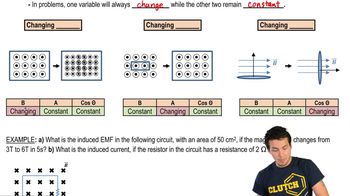
Voltage (EMF) can be induced in a loop of wire by: (1) changing the magnetic field strength (B), (2) changing the area (A) of the loop, or (3) changing the angle (θ) between the magnetic field and the area vector of the loop.
Is an induced current produced in a solenoid when a magnet is moved away from it? Explain why or why not.
Yes, an induced current is produced in a solenoid when a magnet is moved away from it because the movement changes the magnetic flux through the solenoid, and according to Faraday's Law, a changing magnetic flux induces an EMF and thus a current.
What does a changing magnetic field induce in a conducting loop?
A changing magnetic field induces an electromotive force (EMF) in a conducting loop, which can produce an induced current if the loop is part of a closed circuit.
How is the direction of the induced current in a wire determined when the magnetic flux through the wire changes?
The direction of the induced current in a wire is determined by Lenz's Law: the induced current will flow in a direction that creates a magnetic field opposing the change in the original magnetic flux.
State Faraday's Law and explain its significance in electromagnetic induction.
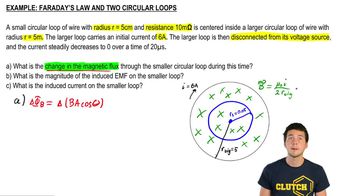
Faraday's Law states that the induced EMF in a coil is equal to the negative rate of change of magnetic flux through the coil, multiplied by the number of turns: EMF = -n (ΔΦ/Δt). It is significant because it quantitatively describes how changing magnetic flux induces voltage and current in a circuit.
How does the number of turns in a coil affect the induced EMF according to Faraday's Law?
The induced EMF is directly proportional to the number of turns in the coil. More turns result in a greater induced EMF for the same change in magnetic flux.
What is the unit of induced EMF as described in Faraday's Law, and why?
The unit of induced EMF is volts because it represents a voltage generated by the changing magnetic flux. This is consistent with the definition of EMF as an electric potential difference.
In a scenario where only the angle between the magnetic field and the area vector changes, which part of the magnetic flux equation is affected?
Only the cosine of the angle (cos θ) in the magnetic flux equation is affected. The magnetic field strength and the area remain constant in this case.
Why is the absolute value used when calculating the induced EMF in Faraday's Law?
The absolute value ensures the induced EMF is always a positive quantity, regardless of whether the magnetic flux increases or decreases. This avoids negative voltage values in the calculation.