What is the first law of thermodynamics and how is it mathematically expressed?
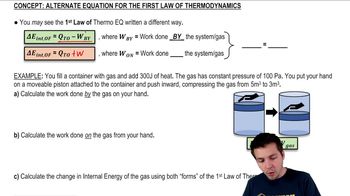
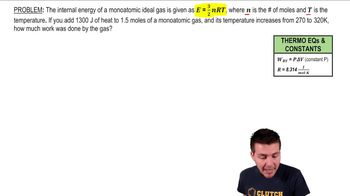
The first law of thermodynamics states that the change in internal energy of a system (ΔE) is equal to the heat added to the system (Q) minus the work done by the system (W): ΔE = Q - W.
State the first law of thermodynamics in words.
The first law of thermodynamics states that energy cannot be created or destroyed; it can only be transferred or transformed. The change in a system's internal energy equals the heat added to the system minus the work done by the system.
In which direction does heat naturally flow between two objects?
Heat naturally flows from a hotter object to a colder object.
How can the first law of thermodynamics be described in terms of energy conservation?
The first law of thermodynamics is a statement of energy conservation, indicating that the total energy of a system changes only by the amount of heat added and the work done by or on the system.
What is a defining characteristic of an adiabatic process in thermodynamics?
An adiabatic process is characterized by no heat transfer into or out of the system (Q = 0); all changes in internal energy are due to work.
What is the general direction of thermal energy flow?
Thermal energy flows from regions of higher temperature to regions of lower temperature.
The first law of thermodynamics is a restatement of which fundamental principle?
The first law of thermodynamics is a restatement of the law of conservation of energy.
What are the two ways that the internal energy of a system can be changed according to the first law of thermodynamics?
Internal energy can be changed by transferring heat (Q) or by doing work (W) on or by the system.
Does heat flow from a hot object to a cold object or from a cold object to a hot object?
Heat flows from a hot object to a cold object.
What does it mean when we say 'energy cannot be created or destroyed' in the context of thermodynamics?
It means that the total energy in a closed system remains constant; energy can only change forms or be transferred between objects, but the total amount does not change.
According to the law of conservation of energy, what happens to the total energy in a closed system?
In a closed system, the total energy remains constant; energy may change forms or be transferred, but it is neither created nor destroyed.
If a system is isolated, what happens to its total energy?
If a system is isolated, its total energy remains constant because no energy is transferred into or out of the system.
 Back
Back
 08:04
08:04