What does areal density refer to in the context of fluids and materials?
Areal density refers to the mass per unit area, typically used for thin sheets or surfaces, and is calculated as mass divided by area.
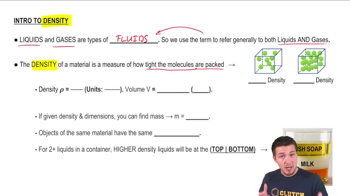
Given an object with a volume of 5 cm³ and a mass of 55 g, how do you calculate its density?
Density is calculated as mass divided by volume. For this object, density = 55 g / 5 cm³ = 11 g/cm³.
If the mass of an object remains constant but its volume increases, what happens to its density?
If mass stays the same and volume increases, density decreases because density is mass divided by volume.
How does air temperature affect the density of air?
As air temperature increases, the density of air decreases because warmer air expands, increasing its volume for the same mass.
By what factor does the density of air change when it is compressed to half its original volume, assuming mass remains constant?
If air is compressed to half its volume, its density doubles, since density is inversely proportional to volume for a constant mass.
A ball has a density of 0.5 g/mL and a mass of 125 grams. How do you calculate its volume?
Volume is calculated as mass divided by density. Volume = 125 g / 0.5 g/mL = 250 mL.
How does the shape of an object affect the method used to measure its volume?
The shape determines the formula used to calculate volume; regular shapes use geometric formulas, while irregular shapes may require displacement methods.
In the context of sound waves, what term refers to the density of the medium's particles at the compression phase?
The density of the medium's particles at the compression of a sound wave is called the compression density.
Can mass and volume be used to predict whether an object will sink or float in water?
Yes, by calculating the object's density and comparing it to water's density; objects denser than water sink, while less dense objects float.
Why does cold air tend to sink in the atmosphere?
Cold air sinks because it is denser than warm air; its molecules are more tightly packed, making it heavier per unit volume.
Does air have mass and volume?
Yes, air has both mass and volume, which is why it has a measurable density.
When a bell is rung, how does the density of air around the bell affect sound transmission?
The density of air around the bell affects how efficiently sound waves travel; higher air density allows sound to travel more effectively.
If the density of a material is constant, how does changing its volume affect its mass?
If density is constant, increasing volume increases mass proportionally, since mass = density × volume.
How is air density commonly described in physics?
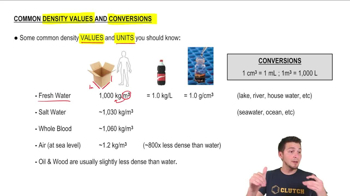
Air density is described as the mass of air per unit volume, typically in kilograms per cubic meter (kg/m³).
How do you calculate the mass of a balsa wood wing with dimensions 27.5 cm × 6 cm × 0.15 cm, given the density of balsa wood?
First, calculate the volume: 27.5 cm × 6 cm × 0.15 cm = 24.75 cm³. Then, mass = density × volume. Use the density of balsa wood to find the mass.
How do you determine the mass of a dragster body with a volume of 150 cm³ made of balsa wood?
Mass = density of balsa wood × 150 cm³. Use the known density value for balsa wood to calculate the mass.
How do you compare the volumes of two cylinders if their dimensions are known?
Calculate each cylinder's volume using the formula V = π × (radius)² × height, then compare the results.
What is true about the mass and volume of objects that sink in water?
Objects that sink in water have a density greater than that of water, meaning their mass-to-volume ratio exceeds water's density.
How do density differences within fluids relate to their behavior in a container?
Fluids with higher density settle at the bottom of a container, while lower density fluids rise to the top, due to gravity.
A table tennis ball has a mass of 2.7 g and a diameter of 40 mm. How do you calculate its density?
First, calculate the volume of the sphere: V = (4/3)πr³, with r = 20 mm = 2 cm. Then, density = mass / volume.
How do you calculate the volume of a cylindrical brass specimen with a diameter of 20 mm?
Use the formula V = π × (radius)² × height, where radius = 10 mm. Multiply by the specimen's height to find the volume.
What is the specific gravity of water?
The specific gravity of water is 1, since the density of water is used as the reference value for specific gravity.
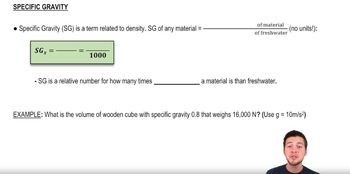
How is specific gravity defined in physics?
Specific gravity is defined as the density of a material divided by the density of freshwater. It is a unitless number that indicates how many times denser a material is compared to water.
What is the specific gravity of air at sea level?
The specific gravity of air at sea level is approximately 0.0012, since the density of air is about 1.2 kg/m³ and the density of water is 1000 kg/m³.
How do you calculate the specific gravity of a material if you know its density?
To calculate the specific gravity of a material, divide its density by the density of freshwater (1000 kg/m³). Specific gravity = (density of material) / (density of water).
 Back
Back

 8:42
8:42