What causes 'pressure' within a wire or, more generally, within a fluid or solid?
Pressure within a material, such as a wire, is created by the force exerted per unit area by the particles (atoms, molecules, or electrons) inside the material. In fluids, pressure arises from the weight of the fluid above and any external forces applied, while in solids like wires, it is due to the internal forces that particles exert on each other when the material is under stress or load.
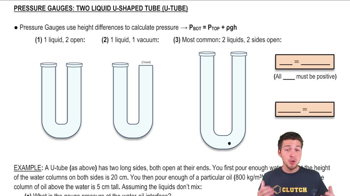
What happens to the liquid levels in a U-shaped tube when both ends are open and the same liquid is used on both sides?
The liquid levels will be equal on both sides because the pressure at both open ends is the same. This results in the liquid seeking the same height on each side.
How does the presence of a vacuum on one side of a U-shaped tube affect the liquid column heights?
The side exposed to atmospheric pressure will have a lower liquid level, while the side under vacuum will have a higher liquid level. This is because the vacuum exerts no pressure, allowing the atmospheric pressure to push the liquid higher on the vacuum side.
Why do two different liquids in a U-shaped tube not reach the same height when both ends are open?
The heights are different because the liquids have different densities, so the pressure balance is achieved with unequal column heights. The denser liquid will have a shorter column compared to the less dense liquid.
What is the significance of the points labeled A, B, C, and D in the U-shaped tube diagram?
Points A and C represent the tops of the left and right columns, while B and D are at the interface or boundary between the two liquids. These points help define the important heights (h1 and h2) and the interface for pressure calculations.
How do you determine which density and height to use when calculating gauge pressure at the interface in a U-shaped tube?
You use the density and height of the liquid directly above the interface where you are calculating the pressure. This ensures the pressure calculation is specific to the liquid column in question.
Why is the total height of liquid in each arm of the U-shaped tube not important for pressure calculations?
Only the height of the liquid column above the point of interest matters for pressure calculations, not the total height in the tube. The pressure depends on the vertical distance and density, not the overall amount of liquid.
What is the purpose of using the absolute value in the equation for delta h in U-shaped tube problems?
The absolute value ensures that the difference in heights is always a positive number, regardless of which side is higher. This avoids negative results and simplifies interpretation.
How is the equation rho1*h1 = rho2*h2 derived for a U-shaped tube with two liquids?
It is derived by equating the pressures at the same horizontal level in both arms, then canceling out the atmospheric pressures and gravity. This leaves the product of density and height for each liquid equal to each other.
What does the gauge pressure represent in the context of a U-shaped tube filled with two liquids?
Gauge pressure is the pressure difference relative to atmospheric pressure at a specific point, such as the liquid interface. It is calculated using the density and height of the liquid column above that point.