Geosynchronous Orbits quiz #1 Flashcards

Geosynchronous Orbits quiz #1
Control buttons has been changed to "navigation" mode.
1/10
  • What is the approximate orbital period of a geosynchronous satellite around Earth?
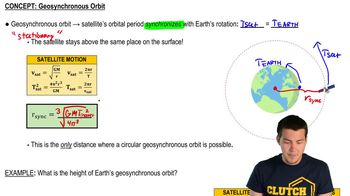
    The orbital period of a geosynchronous satellite around Earth is approximately 24 hours, which matches the Earth's rotation period.
  • What is true about geostationary satellites in terms of their motion relative to the Earth's surface?
    A geostationary satellite remains constantly above the same spot on Earth's equator because its orbital period matches the Earth's rotation period, making it appear stationary relative to the surface.
  • What is the period of a satellite in a geosynchronous orbit around Earth?
    The period of a satellite in a geosynchronous orbit around Earth is 24 hours, the same as the Earth's rotation period.
  • What is the formula for the radius of a synchronous orbit around a planet?
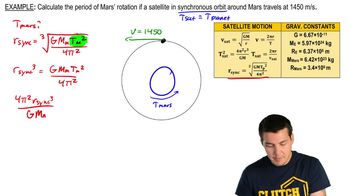
    The formula is r_synchronous = cube root of (G * M * T^2 / (4 * pi^2)), where G is the gravitational constant, M is the planet's mass, and T is the planet's rotation period in seconds. This gives the unique orbital radius for a synchronous orbit.
  • Why is there only one specific orbital radius where a circular geosynchronous orbit is possible?
    There is only one specific radius because the orbital period depends on the radius, and only at this radius does the period match the planet's rotation period. All variables in the formula are constants for a given planet, so the solution is unique.
  • How do you convert Earth's rotation period from hours to seconds for use in orbital calculations?
    Multiply the number of hours (24) by 3,600 seconds per hour to get 86,400 seconds. This value is then used in the synchronous orbit formula.
  • What is the calculated radius of a geosynchronous orbit around Earth in meters?
    The calculated radius is approximately 4.22 x 10^7 meters. This value is obtained by plugging Earth's parameters into the synchronous orbit formula.
  • How do you determine the height above Earth's surface for a geosynchronous satellite?
    Subtract Earth's radius (6.37 x 10^6 meters) from the synchronous orbit radius (4.22 x 10^7 meters). The result is the satellite's height above the surface, about 35,900 kilometers.
  • What practical application is mentioned for geosynchronous orbits in the video?
    Geosynchronous orbits are used in telecommunications because satellites in these orbits appear stationary above a fixed point on Earth. This allows for consistent communication links.
  • What must you be careful about when plugging values into the synchronous orbit formula?
    You must ensure all units are consistent, especially converting time to seconds and using the correct values for G, M, and pi. Parentheses should be used properly in calculations to avoid errors.