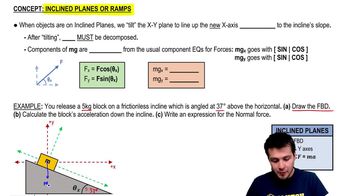
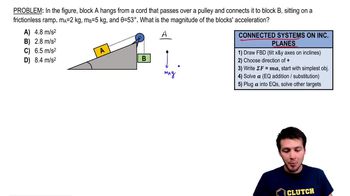
How does the time it takes for a box to reach the bottom of a frictionless incline compare to the time for a disk, and what factors influence this difference?
On a frictionless incline, a box (modeled as a block) and a disk will reach the bottom at different times if rotational inertia is considered. The box, which does not rotate, accelerates faster (a = g sin θ) than the disk, which must also rotate and thus has less acceleration. Therefore, the box reaches the bottom sooner than the disk because it has a greater acceleration down the incline.
 Back
Back
 04:59
04:59