Heat Engines and the Second Law of Thermodynamics quiz #1 Flashcards

Heat Engines and the Second Law of Thermodynamics quiz #1
Control buttons has been changed to "navigation" mode.
1/10
  • What steps can be taken to increase the maximum efficiency of a heat engine according to the principles of thermodynamics?

    To increase the maximum efficiency of a heat engine, you should minimize the amount of waste heat expelled to the cold reservoir (reduce QC) and maximize the heat input from the hot reservoir (increase QH). The efficiency is given by e = 1 - QC/QH, so reducing QC relative to QH increases efficiency. However, due to the second law of thermodynamics, it is impossible to achieve 100% efficiency, as some waste heat must always be expelled.
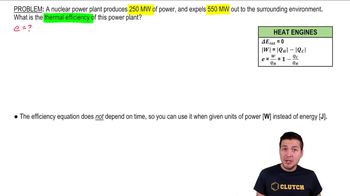
  • How is the thermal efficiency of a heat engine defined in terms of heat and work?

    The thermal efficiency of a heat engine is defined as the ratio of the work output to the heat input: e = W/QH. It can also be expressed as e = 1 - QC/QH, where QH is the heat absorbed from the hot reservoir and QC is the heat expelled to the cold reservoir.
  • Why must every heat engine have a cold reservoir?

    Every heat engine must have a cold reservoir because, according to the second law of thermodynamics, it is impossible to convert all input heat into work. Some waste heat must be expelled to the cold reservoir, making 100% efficiency unattainable and allowing the cyclic process to continue.
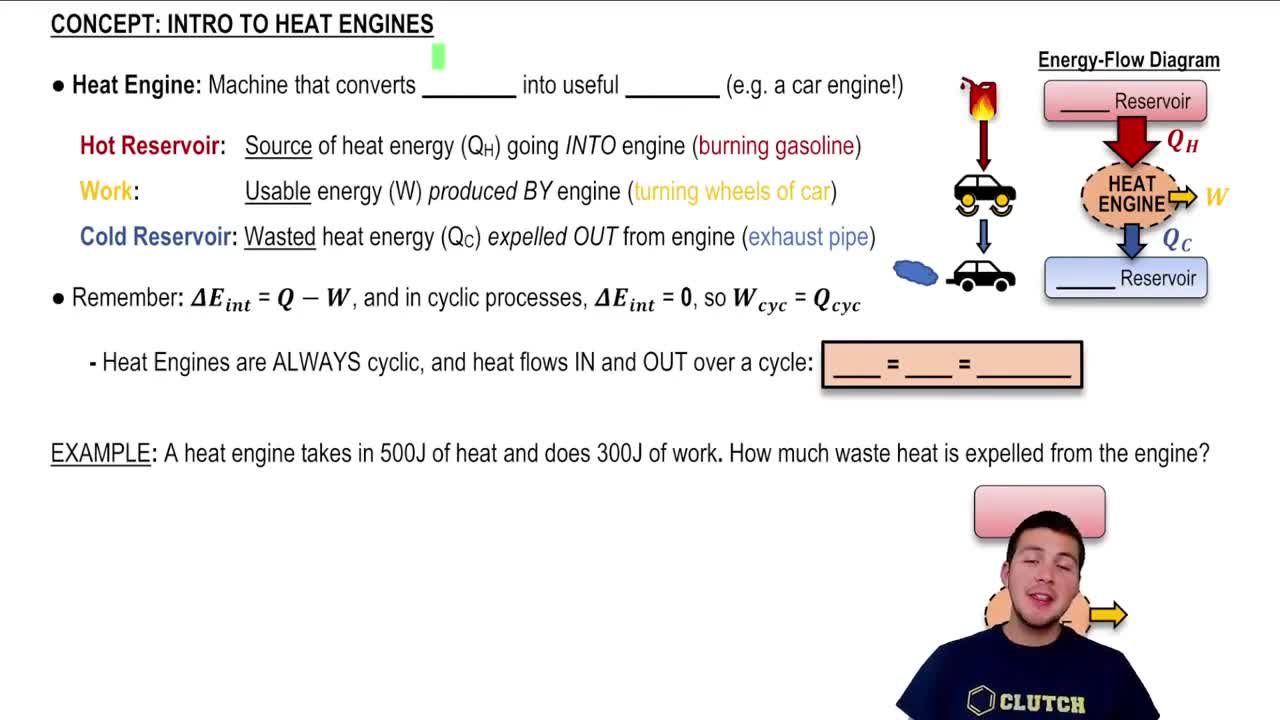
  • A heat engine is a device that uses heat energy to produce useful work. Explain how this process works in terms of energy flow.

    A heat engine operates by absorbing heat energy from a hot reservoir, converting part of this energy into useful work, and expelling the remaining waste heat to a cold reservoir. The process is cyclic, and the work produced is equal to the difference between the heat absorbed and the heat expelled: W = QH - QC.
  • What is the purpose of an energy flow diagram in the context of heat engines?

    An energy flow diagram visually represents the heat transfers between the hot reservoir, the engine, and the cold reservoir. It helps clarify the direction and magnitude of heat and work in any type of heat engine.
  • In a heat engine, what does the term 'reservoir' refer to?

    A reservoir refers to a large source or sink of heat energy, with the hot reservoir supplying heat to the engine and the cold reservoir absorbing the expelled waste heat. These reservoirs are assumed to have constant temperatures during the engine's operation.
  • Why are heat engines described as operating in cyclic processes?

    Heat engines operate in cyclic processes because the sequence of heat intake, work output, and heat expulsion repeats continuously as long as energy is supplied. This allows the engine to perform work repeatedly without accumulating internal energy.
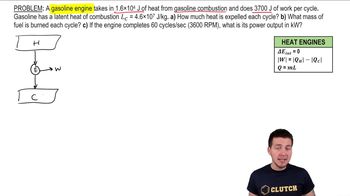
  • How can you calculate the amount of waste heat expelled by a heat engine if you know the heat input and work output?

    The waste heat expelled, QC, is found by subtracting the work output from the heat input: QC = QH - W. This equation follows from the first law of thermodynamics for cyclic processes.
  • What does it mean if a heat engine has an efficiency of 0%, and what does this imply about its operation?

    An efficiency of 0% means the engine produces no useful work from the heat input, so all the input heat is expelled as waste. This implies the engine is completely ineffective at converting heat into work.
  • What fundamental limitation does the second law of thermodynamics impose on the design of heat engines?

    The second law of thermodynamics states that no heat engine can convert all input heat into work, making 100% efficiency impossible. This means every real engine must expel some waste heat to a cold reservoir.