Back

Intro to Pressure quiz #1

Control buttons has been changed to "navigation" mode.
1/12
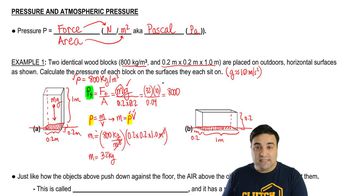
  • How is pressure mathematically related to force, and what are the standard units for pressure?

    Pressure is defined as the force applied per unit area, mathematically given by the formula P = F/A, where P is pressure, F is force, and A is area. The standard unit for pressure is the Pascal (Pa), which is equivalent to one Newton per square meter (N/m²).
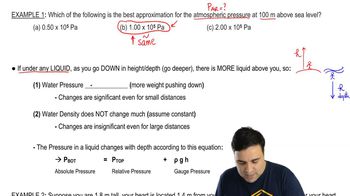
  • What is the physical reason why atmospheric pressure decreases as you ascend in altitude?

    Atmospheric pressure decreases with altitude because there is less air above you, resulting in less weight pressing down. This means the column of air is shorter and exerts less force per unit area.
  • How does the orientation of a block affect the pressure it exerts on a surface, assuming its mass remains constant?

    The orientation affects the contact area with the surface; a larger area results in lower pressure, while a smaller area results in higher pressure. This is because pressure is inversely proportional to the area over which the force is distributed.
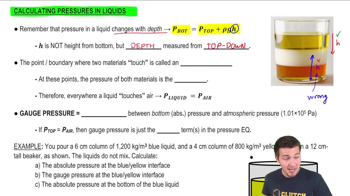
  • Why is the pressure at the bottom of a liquid column greater than at the top?

    The pressure at the bottom is greater because it must support the weight of all the liquid above it. This additional weight increases the force per unit area at greater depths.
  • What is the significance of the interface between two different fluids in a container regarding pressure?

    At the interface between two fluids, the pressure is equal on both sides of the boundary. This ensures a smooth transition in pressure without abrupt changes between the fluids.
  • How do you calculate the force exerted by atmospheric pressure on the top surface of an object?

    Multiply the atmospheric pressure by the area of the object's top surface. This gives the total force applied by the air on that surface.
  • Why are changes in atmospheric pressure with height usually ignored for small vertical distances?

    For small vertical distances, the change in atmospheric pressure is negligible because air density is low and the weight of the air column does not change significantly. Therefore, the pressure remains approximately constant.
  • What is the difference between absolute pressure and gauge pressure in a liquid?

    Absolute pressure is the total pressure at a point, including atmospheric pressure, while gauge pressure is the difference between the absolute pressure and atmospheric pressure. Gauge pressure measures how much greater the pressure is compared to the surrounding atmosphere.
  • When using the equation P_bottom = P_top + ρgh, how should the height h be measured?

    The height h should always be measured as the vertical distance from the top boundary (where P_top is defined) down to the point of interest. It represents the depth below the reference point, not the height from the bottom up.
  • How does the density of a liquid affect the pressure increase with depth?

    A higher density liquid results in a greater increase in pressure with depth because the weight of the liquid above increases more rapidly. The pressure difference is directly proportional to the liquid's density.
  • How is pressure different from force in physics?

    Pressure is defined as force divided by area (P = F/A). While force is a measure of the push or pull on an object (measured in newtons), pressure describes how that force is distributed over a surface (measured in pascals, or newtons per square meter). Thus, the same force can result in different pressures depending on the area over which it is applied.
  • What generates the force that results in hydrostatic pressure within a liquid?

    The force that generates hydrostatic pressure in a liquid is the weight of the liquid above a given point, which is due to gravity acting on the mass of the liquid. This force is calculated as the product of the liquid's density, the acceleration due to gravity, and the depth (height) of the liquid column above the point (F = ρghA), and it is this force distributed over an area that creates hydrostatic pressure.