Intro to Projectile Motion: Horizontal Launch quiz #1 Flashcards

Intro to Projectile Motion: Horizontal Launch quiz #1
Control buttons has been changed to "navigation" mode.
1/36
  • Projectile motion is a combination of which two types of motion?
    Projectile motion combines horizontal motion with zero acceleration and vertical motion with constant acceleration due to gravity.
  • What is the general shape of the path followed by an object in projectile motion?
    An object in projectile motion follows a parabolic path.
  • For a projectile, how are the horizontal and vertical motions related?
    The horizontal and vertical motions of a projectile are independent of each other, with horizontal motion having constant velocity and vertical motion experiencing constant acceleration due to gravity.
  • If you throw a baseball straight up, does it exhibit projectile motion?
    Throwing a baseball straight up is not considered projectile motion in two dimensions; it is one-dimensional vertical motion under gravity.
  • Is mechanical energy conserved for an object in projectile motion (neglecting air resistance)?
    Yes, mechanical energy is conserved for an object in projectile motion if air resistance is neglected.
  • How would you describe the motion of a bungee jumper immediately after launching off a bridge, considering only gravity?
    Immediately after launching, the bungee jumper is in free fall and undergoes projectile motion under the influence of gravity.
  • Why is a baseball thrown by a pitcher considered to have projectile motion?
    A baseball thrown by a pitcher moves in two dimensions under the influence of gravity, making it an example of projectile motion.
  • What are the component motions that make up projectile motion?
    Projectile motion consists of independent horizontal motion (constant velocity) and vertical motion (constant acceleration due to gravity).
  • What is the horizontal acceleration of a projectile?
    The horizontal acceleration of a projectile is zero.
  • What type of path does an object in projectile motion follow?
    An object in projectile motion follows a parabolic path.
  • How can the path of a projectile be represented graphically?
    The path of a projectile can be represented graphically as a parabola.
  • Which statement about projectile motion is incorrect: (a) The horizontal velocity changes during flight, (b) The vertical acceleration is constant, (c) The path is parabolic, (d) The only force acting is gravity?
    Statement (a) is incorrect; the horizontal velocity of a projectile remains constant during flight.
  • How would you describe an object in projectile motion?
    An object in projectile motion moves in two dimensions under the influence of gravity, following a parabolic trajectory.
  • Which scenario best illustrates projectile motion?
    An object launched or thrown at an angle to the horizontal, moving under the influence of gravity, best illustrates projectile motion.
  • Which statement about projectile motion is incorrect: (a) The only acceleration is due to gravity, (b) The horizontal velocity is constant, (c) The vertical velocity is constant, (d) The path is a parabola?
    Statement (c) is incorrect; the vertical velocity of a projectile changes due to gravity.
  • Which statement about projectile motion is incorrect: (a) The horizontal acceleration is zero, (b) The vertical acceleration is -g, (c) The horizontal velocity changes, (d) The path is parabolic?
    Statement (c) is incorrect; the horizontal velocity does not change during projectile motion.
  • At the highest point of a projectile's path, what is the angle between the velocity vector and the vertical?
    At the highest point, the velocity vector is horizontal, so the angle with the vertical is 90 degrees.
  • Which statement about projectile motion is incorrect: (a) The only force acting is gravity, (b) The horizontal velocity is constant, (c) The vertical velocity is constant, (d) The path is a parabola?
    Statement (c) is incorrect; the vertical velocity changes due to gravity.
  • How would you best describe the trajectory of a projectile?
    The trajectory of a projectile is a parabola.
  • What is an example of projectile motion?
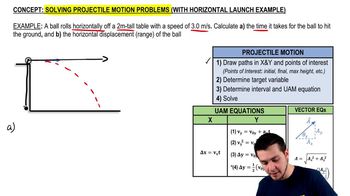
    An example of projectile motion is a ball thrown horizontally from a table.
  • Which of the following is an example of projectile motion?
    A stone thrown at an angle to the ground is an example of projectile motion.
  • Which statement about projectile motion is incorrect: (a) The only acceleration is due to gravity, (b) The horizontal velocity is constant, (c) The vertical velocity is constant, (d) The path is a parabola?
    Statement (c) is incorrect; the vertical velocity changes due to gravity.
  • Which statement about projectile motion is incorrect: (a) The horizontal acceleration is zero, (b) The vertical acceleration is -g, (c) The horizontal velocity changes, (d) The path is parabolic?
    Statement (c) is incorrect; the horizontal velocity remains constant.
  • Which statement about projectile motion is incorrect: (a) The only force acting is gravity, (b) The horizontal velocity is constant, (c) The vertical velocity is constant, (d) The path is a parabola?
    Statement (c) is incorrect; the vertical velocity is not constant.
  • Which statement about projectile motion is incorrect: (a) The only force acting is gravity, (b) The horizontal velocity is constant, (c) The vertical velocity is constant, (d) The path is a parabola?
    Statement (c) is incorrect; the vertical velocity changes due to gravity.
  • What type of path do objects that exhibit projectile motion follow?
    Objects in projectile motion follow a parabolic path.
  • If a football is moving upward and rightward, what type of motion is it exhibiting?
    The football is exhibiting projectile motion, moving in two dimensions under gravity.
  • If gravity can be neglected, what path will an electron follow after being shot horizontally?
    If gravity is neglected, the electron will follow a straight-line path.
  • If a projectile is launched from ground level, what is the general shape of its trajectory?
    A projectile launched from ground level follows a parabolic trajectory.
  • How does a constant wind speed affect the horizontal motion of a projectile?
    A constant wind speed would add a constant horizontal velocity component, but in standard projectile motion analysis (without wind), horizontal velocity remains constant.
  • What happens when a ball is thrown horizontally from the top of a building?
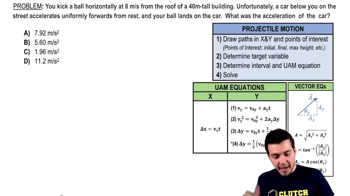
    The ball undergoes projectile motion, moving horizontally at constant velocity while accelerating downward due to gravity, following a parabolic path.
  • When an electron is shot at an initial speed horizontally, what is its vertical acceleration due to gravity?
    The vertical acceleration of the electron is equal to -g (downward acceleration due to gravity).
  • If a shell is shot with an initial velocity at an angle, how can you determine its horizontal and vertical velocity components?
    The horizontal component is v₀ cos(θ), and the vertical component is v₀ sin(θ), where v₀ is the initial speed and θ is the launch angle.
  • How do you calculate the speed of a ball when it leaves a launching ramp in a horizontal launch scenario?
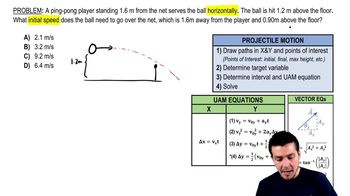
    The speed of the ball as it leaves the ramp is equal to its initial horizontal velocity, since the initial vertical velocity is zero.
  • If a shell is fired with a horizontal velocity, what is its initial vertical velocity?
    If a shell is fired horizontally, its initial vertical velocity is zero.
  • What type of path does a projectile shot directly away from Earth's surface follow under the influence of gravity?
    A projectile shot directly away from Earth's surface follows a parabolic path under the influence of gravity.