What does the coefficient of performance (COP) of a refrigerator represent?
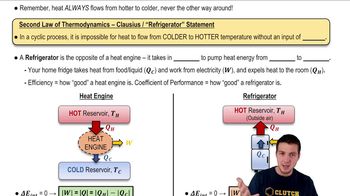
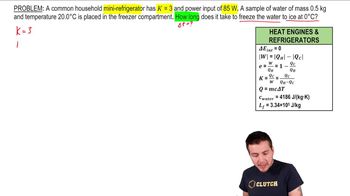
The coefficient of performance (COP) of a refrigerator measures its efficiency by representing the ratio of the heat removed from the cold reservoir (inside the refrigerator) to the work input required to transfer that heat. Mathematically, COP = Q_c / W, where Q_c is the heat extracted from the cold reservoir and W is the work supplied.
What component or process is responsible for cooling the air inside a household refrigerator?
The cooling of air inside a household refrigerator is achieved by extracting heat from the cold reservoir (the interior of the refrigerator) and transferring it to the hot reservoir (the room outside) using work supplied by electricity. This process is accomplished by the refrigerator's internal mechanism, which pumps heat out of the inside compartment.
What is the Clausius statement of the second law of thermodynamics as it relates to refrigerators?
The Clausius statement says that in a cycle, it is impossible for heat to flow from a colder to a hotter body without an input of work. This underlies the operation of refrigerators, which require work to transfer heat from cold to hot.
How does the direction of energy flow in a refrigerator differ from that in a heat engine?
In a refrigerator, energy is transferred from the cold reservoir to the hot reservoir using work input, while in a heat engine, energy naturally flows from hot to cold and some is converted to work. The processes are essentially reversed.
Why is the change in internal energy zero for both heat engines and refrigerators?
Both devices operate in cyclic processes, so the system returns to its initial state after each cycle. This means the net change in internal energy over a complete cycle is zero.
What is the formula for the work required to run a refrigerator in terms of heat exchanged with the reservoirs?
The work required is the absolute value of the difference between the heat expelled to the hot reservoir and the heat extracted from the cold reservoir, or W = |Qh - Qc|. This ensures the work is always a positive value.
How does the coefficient of performance (COP) for a heat pump differ from that of a refrigerator?
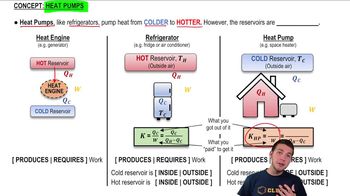
For a heat pump, COP is the heat delivered to the hot reservoir divided by the work input, while for a refrigerator, it is the heat removed from the cold reservoir divided by the work input. The numerator changes depending on the desired output.
In the context of a heat pump, what does a higher coefficient of performance indicate?
A higher coefficient of performance means the heat pump delivers more heat to the hot reservoir per unit of work input. This indicates greater efficiency in heating a space.
How can you calculate the total heat delivered by a heat pump over a period of time using power and COP?
Multiply the COP by the power input and the total time in seconds to get the total heat delivered. The formula is Qh = COP × Power × Δt.
What real-life devices operate on the same principles as refrigerators but are used for heating rather than cooling?
Heat pumps operate on the same principles as refrigerators but are designed to heat spaces by transferring heat from outside to inside. Examples include home heating systems in cold climates.