What are the key characteristics of magnetic field line patterns produced by current-carrying loops and solenoids, and how can you identify if a given field line pattern represents a magnetic field?
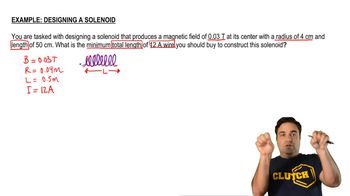
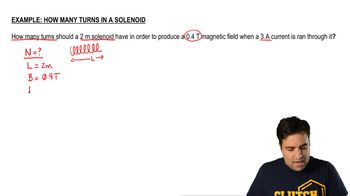
Magnetic field lines produced by current-carrying loops form closed loops: inside the loop (or solenoid), the field lines are nearly straight and uniform, pointing from one face to the other (out of the page for counterclockwise current, into the page for clockwise current at the center). Outside the loop or solenoid, the field lines curve around and return, forming continuous closed loops. In solenoids, the field inside is strong and uniform, while outside it is weaker and resembles the field of a bar magnet, extending from the 'north' to the 'south' pole. A valid magnetic field pattern must have continuous, closed field lines with no beginning or end, and the direction of the field lines should be consistent with the right-hand rule for the current direction.
 Back
Back


 13:54
13:54