What describes the magnetic field that forms when a wire carries an electric current?
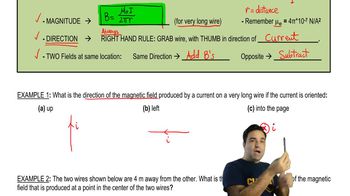
A magnetic field forms in concentric circles around the wire, with the direction given by the right-hand rule: thumb points in the direction of current, and fingers curl in the direction of the magnetic field.
What generates the magnetic field that surrounds a wire carrying an electric current?
The magnetic field is generated by the moving charges (electric current) within the wire.
How do you determine the magnetic field at a point near a straight current-carrying wire?
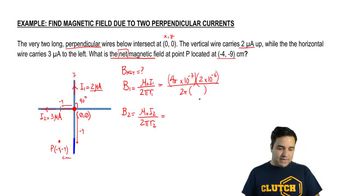
The magnetic field at a distance r from a long straight wire carrying current I is given by B = (mu_0 * I) / (2 * pi * r), where mu_0 is the permeability of free space. The direction is found using the right-hand rule.
What is the source of the magnetic field in a current-carrying wire?
The source of the magnetic field is the movement of electric charges (current) through the wire.
What causes the magnetic field around a wire?
The magnetic field around a wire is caused by the flow of electric current, which consists of moving charges.
If a vertical wire carries a current straight down, what is the direction of the magnetic field to the east of this wire?
To the east of a vertical wire with current flowing straight down, the magnetic field points into the page (or screen), as determined by the right-hand rule.
How do you determine the direction of current in a long, straight wire that extends into and out of the screen using the magnetic field?
The direction of current can be determined using the right-hand rule: if the magnetic field circles clockwise around the wire, the current is directed into the screen; if counterclockwise, the current is out of the screen.
What is the formula for the magnitude of the magnetic field produced by a long straight wire at a distance r from the wire?
The magnitude of the magnetic field is B = (mu_0 * I) / (2 * pi * r), where I is the current and r is the perpendicular distance from the wire.
How do you verify if the magnetic field 10 cm from a wire carrying a 1 A current is 2 μT?
Use the formula B = (mu_0 * I) / (2 * pi * r). Substitute mu_0 = 4π × 10⁻⁷ T·m/A, I = 1 A, and r = 0.1 m to calculate B and compare the result to 2 μT.
How does the direction of the net magnetic field at a point between two parallel wires with currents in opposite directions get determined?
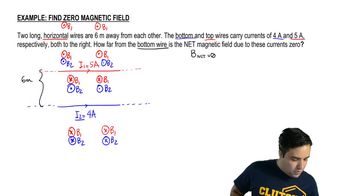
The net magnetic field is found by subtracting the smaller field from the larger one, taking the direction of the larger field. The direction is determined by the right-hand rule for each wire and the field with the greater magnitude dominates.
What causes the magnetic field around a straight current-carrying wire?
The magnetic field around a straight current-carrying wire is caused by moving electric charges (the electric current) within the wire. As charges move, they generate a magnetic field whose magnitude is given by B = (μ₀I)/(2πr), where μ₀ is the permeability of free space, I is the current, and r is the perpendicular distance from the wire.
 Back
Back

 07:55
07:55