Control buttons has been changed to "navigation" mode.
1/10
Terms in this set (10)
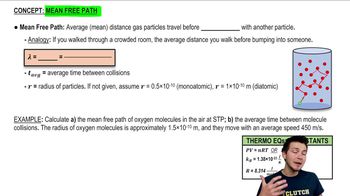
How can you calculate the mean free time between collisions for electrons (or any particles) in a material, and what is the general formula for this time?
The mean free time between collisions (t_avg) for particles is calculated by dividing the mean free path (λ) by the average velocity (v_avg) of the particles: t_avg = λ / v_avg. This gives the average time a particle travels before colliding with another particle.
Given that the mean free path of a helium atom in helium gas at standard temperature and pressure is 0.2 micrometers, how can you determine the average time between collisions for a helium atom?
To determine the average time between collisions for a helium atom, use the formula t_avg = λ / v_avg, where λ is the mean free path (0.2 micrometers) and v_avg is the average velocity of helium atoms. The average velocity can be estimated using kinetic theory if needed.
What does the mean free path represent in the context of gas particles in a container?
The mean free path is the average distance a gas particle travels before colliding with another particle. It reflects how far, on average, a particle moves in a straight line between collisions.
How does increasing the number of gas particles in a container affect the mean free path?
Increasing the number of gas particles decreases the mean free path. This is because more particles lead to more frequent collisions, reducing the average distance between them.
What is the effect of increasing the radius of gas particles on the mean free path?
Increasing the radius of gas particles decreases the mean free path. Larger particles have a greater chance of colliding, so the average distance between collisions becomes shorter.
Which variables from the ideal gas law are used to express the mean free path when volume and number of particles are unknown?
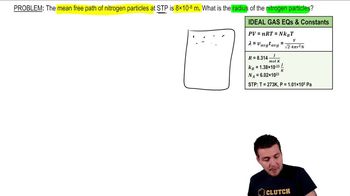
Pressure (P) and temperature (T) from the ideal gas law are used to express the mean free path when volume and number of particles are unknown. The ratio V/N can be written in terms of kBT/P.
What is the formula for the mean free path in terms of particle radius and number of particles?
The mean free path is given by λ = V / (√2 × 4πr²N), where V is volume, r is particle radius, and N is the number of particles. This formula relates microscopic properties to macroscopic variables.
Why is the mean free path for oxygen molecules at STP so small?
The mean free path is small because there are a large number of oxygen molecules packed closely together at STP. This high density leads to frequent collisions and short distances between them.
How can you use the ideal gas law to find the ratio V/N for a gas at known temperature and pressure?
By rearranging the ideal gas law, V/N = kBT/P, where kB is Boltzmann's constant, T is temperature, and P is pressure. This allows calculation of V/N without knowing V or N individually.
What does a very short average time between collisions indicate about the motion of gas particles?
A very short average time between collisions means gas particles are colliding extremely frequently. This is typical in gases with high particle density and high average speeds.