How do you determine the speed of a car at the bottom of a dip along a curved path using energy conservation principles?
To determine the speed of a car at the bottom of a dip along a curved path, use the conservation of mechanical energy. Set the initial potential and kinetic energies at the starting point and equate them to the final potential and kinetic energies at the bottom, assuming no energy is lost to friction. The general formula is: (1/2) m v_initial^2 + m g h_initial = (1/2) m v_final^2 + m g h_final. At the bottom, h_final is minimum (often zero), so solve for v_final: v_final = sqrt(v_initial^2 + 2g(h_initial - h_final)).
How is the movement of an object from one point to another along a curved path best described in terms of energy conservation?
The movement of an object from one point to another along a curved path is best described using the principle of energy conservation. The object's total mechanical energy (kinetic plus potential) remains constant if there are no non-conservative forces like friction. As the object moves along the curve, potential energy is converted to kinetic energy or vice versa, depending on changes in height.
How can you analyze the motion of a toy car coasting along a curved track using energy conservation?
To analyze the motion of a toy car coasting along a curved track, apply the conservation of mechanical energy. Set the sum of the car's initial kinetic and potential energies equal to the sum of its final kinetic and potential energies at another point on the track, assuming negligible friction. This allows you to solve for the car's speed or height at various points along the track.
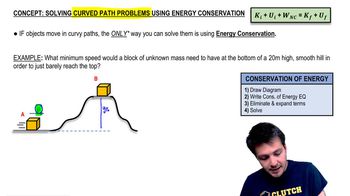
Why can't you use kinematics to solve for the minimum speed needed to reach the top of a curved hill?
Kinematics assumes constant acceleration, but along a curved path, the acceleration changes due to the varying slope angle. Therefore, kinematics is not applicable in this scenario.
What happens to the component of gravitational force acting on a block as it moves along a curved path?
The direction and magnitude of the gravitational force component change continuously as the slope angle varies along the path. This results in non-constant acceleration.
In the absence of friction, what term is omitted from the energy conservation equation for a block moving up a hill?
The work done by non-conservative forces is omitted because there is no friction or applied force. This simplifies the equation to only include kinetic and potential energies.
Why is the final kinetic energy set to zero when calculating the minimum speed to just reach the top of a hill?
Setting the final kinetic energy to zero ensures the block just barely reaches the top without any leftover speed. Any remaining kinetic energy would mean the initial speed was more than the minimum required.
How does the changing slope angle of a curved path affect the analysis of motion using forces?
The changing slope angle causes the direction of the force components to vary, making force analysis complex and impractical. This is why energy methods are preferred for such problems.
What is the significance of setting the initial potential energy to zero at the base of the hill?
Setting the initial potential energy to zero provides a convenient reference point for calculating energy changes. It simplifies the energy conservation equation by eliminating the initial potential energy term.
What would happen if the block's initial speed was less than the calculated minimum speed needed to reach the top?
If the initial speed is less than the minimum, the block will not reach the top and will slide back down. The minimum speed ensures just enough energy to reach the peak.