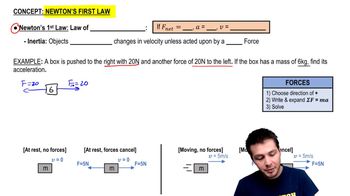
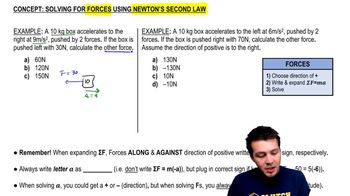
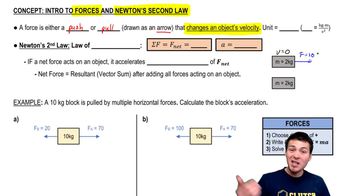
An unbalanced force is when the sum of all forces acting on an object does not equal zero, resulting in a change in the object's motion (acceleration).
Under what condition can an object at rest remain at rest?
An object at rest will remain at rest if the net force acting on it is zero.
What happens if an unbalanced force acts on an object?
If an unbalanced force acts on an object, the object will accelerate in the direction of the net force.
What are balanced forces?
Balanced forces are forces that are equal in magnitude and opposite in direction, resulting in a net force of zero and no change in the object's motion.
What is the effect on a box if equal and opposite forces act on it?
If equal and opposite forces act on a box, the net force is zero and the box will not accelerate; its velocity remains constant.
What is the relationship between heavy objects and inertia?
Heavier objects (greater mass) have more inertia, meaning they resist changes in their motion more than lighter objects.
What was Galileo’s contribution to the study of motion?
Galileo contributed the idea that objects in motion remain in motion unless acted upon by an external force, laying the groundwork for Newton's first law.
How does an airbag help protect a passenger in a car accident?
An airbag helps protect a passenger by increasing the time over which the force acts during a collision, reducing the acceleration and force experienced by the passenger.
Will the velocity of a book change as it moves across a surface with no friction?
No, if there is no friction and no net force, the book's velocity will remain constant according to Newton's first law.
What does Newton's first law of motion state?
Newton's first law states that an object will remain at rest or in uniform motion unless acted upon by a net external force.
What force would result in balanced forces during a game?
Balanced forces occur when all forces acting on an object are equal in magnitude and opposite in direction, resulting in no net force.
What are Newton's three laws of motion?
Newton's three laws are: (1) Law of inertia, (2) F=ma (law of acceleration), and (3) For every action, there is an equal and opposite reaction.
What refers to an object's resistance to any change in its motion?
Inertia refers to an object's resistance to any change in its motion.
If a block is moving to the left at constant velocity, what does this indicate about the forces acting on it?
If a block moves to the left at constant velocity, the forces acting on it are balanced and the net force is zero.
What is the difference between a balanced and unbalanced force?
Balanced forces result in no change in motion (net force is zero), while unbalanced forces cause acceleration (net force is not zero).
What does it mean to say that force and acceleration have a direct relationship?
A direct relationship means that as the net force on an object increases, its acceleration increases proportionally (F=ma).
True or false? Balanced forces cause a change in motion.
False. Balanced forces do not cause a change in motion.
What is force measured in?
Force is measured in newtons (N).
What is the difference between a balanced force and an unbalanced force?
A balanced force results in zero net force and no acceleration, while an unbalanced force results in a nonzero net force and causes acceleration.
What happens if the net force on an object is zero?
If the net force is zero, the object will remain at rest or continue moving at constant velocity.
What forces control the motion of everyday objects?
The motion of everyday objects is controlled by the net force, which is the sum of all individual forces acting on the object.
Which force causes acceleration?
An unbalanced (net) force causes acceleration.
What does Newton’s first law state?
Newton's first law states that an object will remain at rest or move at constant velocity unless acted upon by a net external force.
True or false? Unbalanced forces cause a change in motion. How do you know this?
True. Unbalanced forces result in a nonzero net force, which causes acceleration and changes the object's motion.
What is the difference between an unbalanced force on an object and balanced forces on an object?
Unbalanced forces cause acceleration, while balanced forces result in no change in motion.
What state is an object in when all forces are balanced?
When all forces are balanced, the object is either at rest or moving at constant velocity.
What is net force?
Net force is the vector sum of all forces acting on an object.
What is applied force?
Applied force is a force that is intentionally exerted on an object by another object or person.
What is the relationship between mass and inertia?
Mass is a measure of an object's inertia; greater mass means greater resistance to changes in motion.
What keeps the springs of a suspension system from bouncing continuously?
Balanced forces and damping mechanisms keep the springs from bouncing continuously by counteracting motion.
If a force is exerted on an object, what happens?
If a net force is exerted on an object, it will accelerate in the direction of the force.
How is force proportional to acceleration?
Force is directly proportional to acceleration, as described by F=ma.
What does Newton's first law state?
Newton's first law states that an object will remain at rest or in uniform motion unless acted upon by a net external force.
Under what condition will an object have zero acceleration?
An object will have zero acceleration if the net force acting on it is zero.
What net force would result in no change in motion?
A net force of zero results in no change in motion.
What is true of non-contact forces?
Non-contact forces, such as gravity, can act on objects without physical contact.
What causes an object to move?
An object moves when a net force acts on it.
What do unbalanced forces cause?
Unbalanced forces cause acceleration, changing the speed or direction of an object's motion.
A newton is equivalent to which quantities?
A newton is equivalent to 1 kg·m/s².
When the net force on an object is zero, what happens?
When the net force is zero, the object remains at rest or moves at constant velocity.