Newton's First & Second Laws quiz #4 Flashcards

Newton's First & Second Laws quiz #4
Control buttons has been changed to "navigation" mode.
1/40
  • Once a crate is sliding, what keeps it moving?
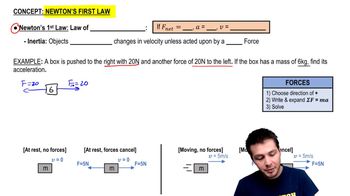
    Inertia keeps the crate moving unless acted upon by a net force (such as friction).
  • Which example illustrates Newton's first law?
    A book remaining at rest on a table until pushed illustrates Newton's first law.
  • What is required in order to determine whether or not an object moves?
    You must determine if there is a net force acting on the object.
  • How can the motion of an object that is already moving change?
    The motion can change if an unbalanced force acts on the object.
  • Which statement describes a newton?
    A newton is the unit of force, equal to 1 kg·m/s².
  • What causes objects to move or stay still?
    Objects move or stay still depending on whether the net force acting on them is zero or not.
  • What property of matter will keep your body in motion when the car comes to a halt?
    Inertia keeps your body in motion when the car stops suddenly.
  • What makes stopping quickly in a curve more difficult?
    Inertia makes stopping quickly in a curve more difficult because the vehicle resists changes in direction and speed.
  • What happens when you decrease the thrust on your scooter?
    Decreasing thrust reduces the net force, causing the scooter to slow down (decelerate).
  • True or false? If friction didn't exist, what would happen to a moving object?
    True. If friction didn't exist, a moving object would continue moving at constant velocity.
  • Which of the following best explains Newton's second law?
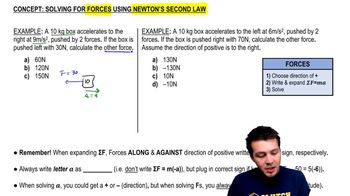
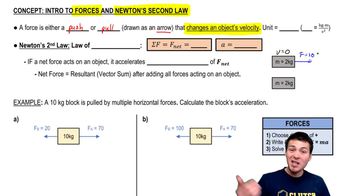
    Newton's second law states that the net force on an object equals its mass times its acceleration (F=ma).
  • How do Newton’s laws affect your daily life?
    Newton's laws explain everyday phenomena such as motion, stopping, and the effects of forces on objects.
  • A metal ball sits motionless on a flat surface. What would make the ball move?
    An unbalanced force applied to the ball would make it move.
  • How does a wrecking ball have the potential to exert force on another object?
    A wrecking ball can exert force due to its mass and acceleration when it swings and strikes another object.
  • In what situations do Newton’s laws of motion not apply?
    Newton's laws do not apply in non-inertial (accelerating) reference frames or at relativistic speeds.
  • Which of Newton’s laws is defined with the equation F=ma?
    Newton's second law is defined by F=ma.
  • Which method will correctly determine whether the forces on an object are balanced or unbalanced?
    Calculate the vector sum of all forces; if the net force is zero, forces are balanced; otherwise, they are unbalanced.
  • What will happen to a test dummy during a crash test if its seatbelt is not buckled?
    The dummy will continue moving forward due to inertia until acted upon by another force.
  • What physics principle results in a spinout?
    Unbalanced forces and inertia can result in a spinout when a vehicle loses traction.
  • Francisco is holding two magnets close to each other. What will happen when he lets go?
    The magnets will move according to the net force between them (attraction or repulsion).
  • The force with which a moving object hits another object is called what?
    It is called impact force.
  • What does ΣF = 0 mean?
    ΣF = 0 means the sum of all forces (net force) is zero; the object will not accelerate.
  • What does the second part of Newton’s first law say about objects at rest?
    Objects at rest remain at rest unless acted upon by a net external force.
  • Name three factors that affect the force of impact. Which of these can a driver control?
    Mass, acceleration, and time of impact affect force; a driver can control speed (acceleration) and time of impact (by braking).
  • A constant net force acts on an object. How does the object's motion change?
    The object accelerates at a constant rate in the direction of the net force.
  • An object cannot remain at rest unless which condition holds?
    The net force acting on the object must be zero.
  • Which situation is the best example of inertia?
    A passenger continuing forward when a car stops suddenly is an example of inertia.
  • How could you tell if a moving object is receiving an unbalanced force?
    If the object's speed or direction changes, it is receiving an unbalanced force.
  • Who came up with the three laws of motion?
    Isaac Newton came up with the three laws of motion.
  • What does Newton’s second law of motion say about football?
    Newton's second law explains that the acceleration of a football depends on the net force applied and its mass.
  • For a stationary box to move, what must be applied?
    An unbalanced force must be applied to the box.
  • Why does a spaceship with no forces acting on it continue moving even if it has no fuel?
    Due to inertia, the spaceship continues moving at constant velocity unless acted upon by a net force.
  • A bicycle that travels twice as fast as another when braking to a stop will skid how far compared to the slower one?
    The faster bicycle will skid a greater distance because it has more momentum to overcome.
  • A 10-N falling object encounters 10 N of air resistance. What is the net force on the object?
    The net force is zero (10 N downward minus 10 N upward).
  • When a pair of 10-N forces act on a box of candy in opposite directions, what is the net force?
    The net force is zero.
  • A large rock is motionless on a flat sidewalk. Why?
    The forces acting on it are balanced; net force is zero.
  • When Marie pushes her desk to the right, which direction does friction act?
    Friction acts to the left, opposing the direction of motion.
  • What takes longer to stop than a car traveling at the same speed?
    Heavier vehicles take longer to stop than lighter ones at the same speed.
  • If a monkey floating in outer space throws his hat away, what happens?
    Both the monkey and the hat move in opposite directions due to conservation of momentum and Newton's third law.
  • If a ball rolls at a constant rate on a flat surface, what is the net force acting on it?
    The net force is zero if it moves at constant velocity.