Parallel Plate Capacitors quiz #1 Flashcards

Parallel Plate Capacitors quiz #1
Control buttons has been changed to "navigation" mode.
1/10
  • What is the formula for the capacitance of a parallel plate capacitor, and how does the electric field behave between and outside the plates?
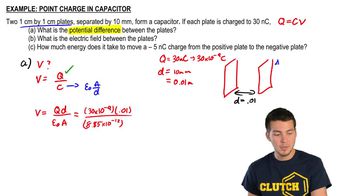
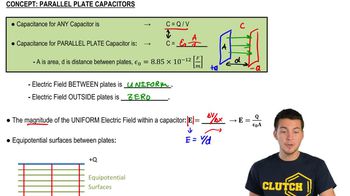
    The capacitance of a parallel plate capacitor is given by C = (ε₀ × A) / d, where ε₀ is the vacuum permittivity, A is the area of each plate, and d is the separation between the plates. The electric field between the plates is uniform and can be calculated as E = Q / (ε₀ × A) or E = V / d, where Q is the charge on the plates and V is the potential difference. Outside the plates, the electric field quickly approaches zero.
  • What is the relationship between the direction of electric field lines and equipotential surfaces in a parallel plate capacitor?
    The electric field lines are always perpendicular to the equipotential surfaces. This means the field points in the direction of decreasing potential.
  • How does the shape of the plates in a parallel plate capacitor affect the calculation of capacitance?
    The shape of the plates does not affect the capacitance calculation as long as the area is known. The formula uses the total area, regardless of whether the plates are rectangular, circular, or another shape.
  • Why must you convert all measurements to SI units when calculating capacitance or electric field in a parallel plate capacitor?
    Using SI units ensures consistency and correctness in calculations, as the formulas are derived with these units in mind. For example, area should be in square meters and distance in meters.
  • What happens to the electric field outside the plates of a parallel plate capacitor?
    The electric field outside the plates quickly approaches zero. This is because the fields from the two plates largely cancel each other out beyond the edges.
  • How can you calculate the charge stored on a parallel plate capacitor if you know its capacitance and the voltage applied?
    The charge can be calculated using Q = C × V, where Q is the charge, C is the capacitance, and V is the voltage. This formula directly relates the stored charge to the applied voltage.
  • What is the significance of the vacuum permittivity constant (epsilon naught) in the capacitance formula?
    The vacuum permittivity constant, ε₀, determines how much electric field is permitted in a vacuum. It is a fundamental constant that appears in the capacitance formula to account for the medium between the plates.
  • Why is the electric field between the plates of a parallel plate capacitor considered uniform?
    The electric field is uniform because the plates are large and parallel, causing the field lines to be evenly spaced and parallel between them. This uniformity holds except near the edges of the plates.
  • What is the effect of increasing the separation distance between the plates on the capacitance of a parallel plate capacitor?
    Increasing the separation distance decreases the capacitance, as capacitance is inversely proportional to the distance between the plates. This means the plates can store less charge for a given voltage.
  • How can you use two different formulas to calculate the electric field between the plates, and why do they give the same result?
    You can use either E = Q / (ε₀ × A) or E = V / d to calculate the electric field between the plates. Both formulas yield the same result because they are derived from the same physical relationships in a parallel plate capacitor.