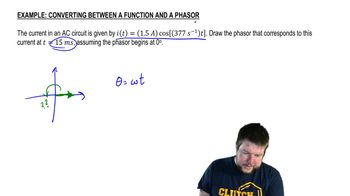
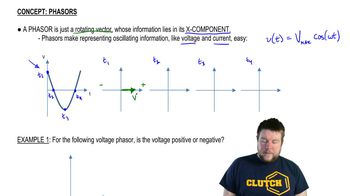
How do you draw a phasor diagram to show the relationship between three voltage phasors, v1, v2, and v3, and how do you determine the net phasor?
To draw a phasor diagram for three voltage phasors v1, v2, and v3, represent each phasor as an arrow (vector) originating from a common point. The direction and length of each arrow correspond to the phase and magnitude of each voltage. To find the net phasor, add the vectors head-to-tail: combine v1 and v3 if they are along the same axis (subtracting if they are in opposite directions), then add v2 if it is perpendicular. The resulting net phasor is the vector sum of v1, v2, and v3, and its direction and length represent the total voltage's phase and magnitude. The x-component of the net phasor determines whether the resulting voltage is positive (points right) or negative (points left).
 Back
Back
 08:32
08:32