Skip to main content
Physics
My Course
Learn
Exam Prep
AI Tutor
Study Guides
Textbook Solutions
Flashcards
Explore
Try the app
My Course
Learn
Exam Prep
AI Tutor
Study Guides
Textbook Solutions
Flashcards
Explore
Try the app
Back
Resistors in AC Circuits definitions
You can tap to flip the card.
Resistor
You can tap to flip the card.
👆
Resistor
A component that opposes the flow of electric current, causing a voltage drop.
Track progress
Control buttons has been changed to "navigation" mode.
1/12
Related flashcards
Related practice
Recommended videos
Resistors in AC Circuits quiz #1
Resistors in AC Circuits
10 Terms
Resistors in AC Circuits
31. Alternating Current
1 problem
Topic
Patrick
31. Alternating Current - Part 1 of 2
5 topics
11 problems
Chapter
Patrick
31. Alternating Current - Part 2 of 2
5 topics
11 problems
Chapter
Patrick
Guided course
02:32
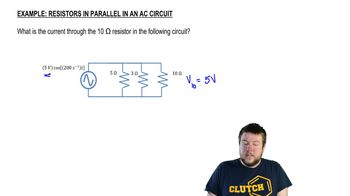
Resistors in Parallel in an AC Circuit
3008
views
45
rank
3
comments
Guided course
03:12
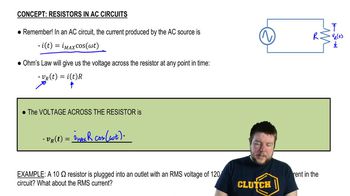
Resistors in AC Circuits
3554
views
28
rank
2
comments
Terms in this set (12)
Hide definitions
Resistor
A component that opposes the flow of electric current, causing a voltage drop.
AC Circuit
An electrical circuit powered by an alternating current, where the current changes direction periodically.
Sinusoidal
A waveform that describes a smooth periodic oscillation, typical of AC current.
Ohm's Law
A principle stating that the current through a conductor is directly proportional to the voltage across it.
Voltage
The electrical potential difference between two points, driving current through a circuit.
Current
The flow of electric charge in a circuit, measured in amperes.
Resistance
A measure of the opposition to current flow in an electrical circuit, measured in ohms.
RMS Voltage
The root mean square value of voltage, representing the effective value of a varying voltage.
RMS Current
The root mean square value of current, representing the effective value of a varying current.
Maximum Current
The peak value of current in an AC circuit, calculated as RMS current times the square root of two.
Equivalent Resistor
A single resistor that can replace a combination of resistors in a circuit without changing the current.
Omega
The angular frequency of a sinusoidal waveform, representing how fast the waveform oscillates.
 BackBack
 02:32
02:32