Pearson+ LogoPearson+ Logo
Back

Review of Vectors vs. Scalars quiz #1

Control buttons has been changed to "navigation" mode.
1/14
  • Which of the following physical quantities is a scalar and not a vector?

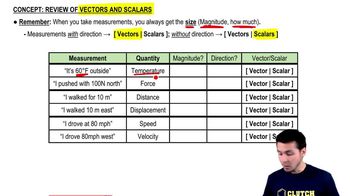
    A scalar quantity, such as temperature or speed, has magnitude only and no direction, unlike a vector quantity.
  • If two vectors are not perpendicular to each other, how does this affect their addition?

    If two vectors are not perpendicular, their addition must account for both magnitude and direction, typically using vector components or the law of cosines, rather than simple arithmetic addition.
  • Does speed have direction?

    No, speed does not have direction; it is a scalar quantity and only has magnitude.
  • What is the difference between a vector and a scalar quantity in physics?

    A vector quantity has both magnitude and direction, while a scalar quantity has only magnitude and no direction.
  • How do scalar and vector quantities differ?

    Scalar quantities have only magnitude, whereas vector quantities have both magnitude and direction.
  • Explain the distinction between a scalar quantity and a vector quantity.

    A scalar quantity is described by its magnitude alone, while a vector quantity is described by both its magnitude and its direction.
  • Describe the difference between a vector quantity and a scalar quantity.

    A vector quantity includes both magnitude and direction, whereas a scalar quantity includes only magnitude.
  • Which statements about vectors and scalars are true according to physics principles?

    Vectors have both magnitude and direction; scalars have only magnitude. Examples of vectors include force and displacement, while examples of scalars include temperature and distance.
  • Why is temperature considered a scalar quantity in physics?

    Temperature is considered a scalar because it only has magnitude and does not involve any direction. It makes no sense to specify a direction for temperature measurements.
  • How does specifying a direction change the classification of a measurement from scalar to vector?

    Specifying a direction adds directional information to the magnitude, making the measurement a vector. Without direction, the measurement remains a scalar.
  • How are speed and velocity related in physics?

    Speed and velocity both describe how fast something is moving, but speed is a scalar (only magnitude) while velocity is a vector (magnitude and direction).
  • What is the main difference between speed and velocity?

    The main difference is that speed is a scalar quantity with only magnitude, while velocity is a vector quantity with both magnitude and direction.
  • How does velocity differ from speed?

    Velocity differs from speed because velocity includes both the magnitude and the direction of motion, whereas speed includes only the magnitude.
  • How is speed different from velocity?

    Speed is different from velocity because speed does not include direction, making it a scalar, while velocity includes direction, making it a vector.