What are the key postulates and consequences of Einstein's Special Relativity, and how do they differ from Galilean Relativity?
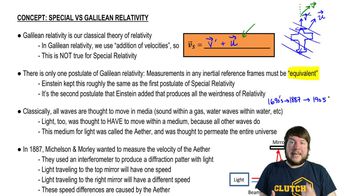
Einstein's Special Relativity is based on two postulates: (1) the laws of physics are the same in all inertial frames, and (2) the speed of light in a vacuum is constant and independent of the motion of the source or observer, in all inertial frames. Unlike Galilean Relativity, which uses simple addition of velocities and allows for speeds exceeding the speed of light, Special Relativity modifies velocity addition so that no object can exceed the speed of light. Special Relativity also leads to phenomena such as time dilation and length contraction, meaning that measurements of time and space depend on the observer's inertial frame. These effects are not present in Galilean Relativity.
 Back
Back
 17:25
17:25