Physics
My Course
Learn
Exam Prep
AI Tutor
Study Guides
Textbook Solutions
Flashcards
Explore
My Course
Learn
Exam Prep
AI Tutor
Study Guides
Textbook Solutions
Flashcards
Explore
Back
Static Friction definitions
You can tap to flip the card.
Static Friction
You can tap to
flip the card.
👆
Static Friction
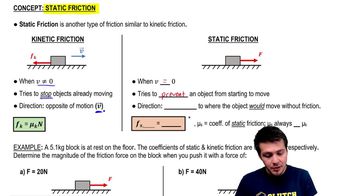
A force that prevents an object at rest from starting to move, opposing the direction it would move without friction.
Track progress
Control buttons has been changed to "navigation" mode.
1/10
Related flashcards
Related practice
Recommended videos
Guided course
08:11
Static Friction & Equilibrium
Patrick
11274
views
200
rank
6
comments
Guided course
04:05
Static & Kinetic Friction
Patrick
7883
views
136
rank
3
comments
Guided course
04:33
Preventing a Block From Moving
Patrick
6347
views
118
rank
3
comments
Terms in this set (10)
Hide definitions
Static Friction
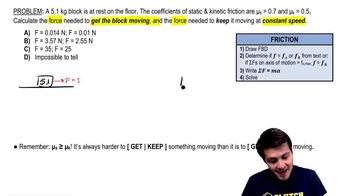
A force that prevents an object at rest from starting to move, opposing the direction it would move without friction.
Kinetic Friction
A constant opposing force acting on a moving object, calculated as the coefficient of kinetic friction times the normal force.
Coefficient of Static Friction
A dimensionless value greater than the coefficient of kinetic friction, representing the ratio of maximum static friction to normal force.
Coefficient of Kinetic Friction
A dimensionless value representing the ratio of kinetic friction to normal force, typically less than the coefficient of static friction.
Normal Force
The perpendicular force exerted by a surface on an object in contact with it, balancing the object's weight.
Threshold
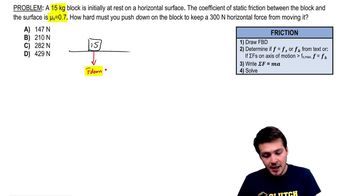
The maximum static friction force that must be overcome to initiate motion in an object at rest.
Free Body Diagram
A graphical representation showing all the forces acting on an object, used to analyze the object's motion.
Newton
The SI unit of force, symbolized as N, defined as the force required to accelerate a 1 kg mass by 1 m/s².
Force
An interaction that changes the motion of an object, measured in newtons, and can be applied in various directions.
Acceleration
The rate of change of velocity of an object, resulting from unbalanced forces acting on it.