Pearson+ LogoPearson+ Logo
Back

Static Friction quiz #1

Control buttons has been changed to "navigation" mode.
1/13
  • What is the difference between static friction and kinetic friction?

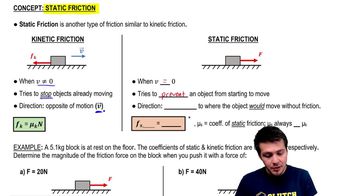
    Static friction acts on objects at rest and prevents them from starting to move, while kinetic friction acts on moving objects and opposes their motion. The coefficient of static friction is always greater than that of kinetic friction.
  • Why do clothes often cling together after tumbling in a clothes dryer?

    Clothes cling together after tumbling in a dryer due to static electricity, which causes an electrostatic attraction between the fabrics.
  • Which type of friction acts on an object that is not moving?

    Static friction acts on an object that is not moving.
  • What is the minimum possible coefficient of static friction required to prevent a bicycle from slipping on the ground?

    The minimum coefficient of static friction required to prevent slipping is determined by the ratio of the maximum horizontal force to the normal force: μ_s = F_max / N, where F_max is the maximum force before slipping and N is the normal force.
  • Why do you get a shock when you walk across a carpet?

    You get a shock when you walk across a carpet because friction between your shoes and the carpet generates static electricity, which discharges when you touch a conductor.
  • Which type of kinetic friction is generally more difficult to overcome: sliding or rolling?

    Sliding kinetic friction is generally more difficult to overcome than rolling kinetic friction because the coefficient of sliding friction is higher.
  • In which direction does the static friction force act on a block being pushed but not yet moving?

    The static friction force acts in the direction opposite to where the block would move if there were no friction.
  • What is the minimum coefficient of static friction required to prevent an object from sliding?

    The minimum coefficient of static friction required to prevent sliding is μ_s = F_applied / N, where F_applied is the applied force and N is the normal force.
  • How do you find the coefficient of static friction between a rod and rails?

    To find the coefficient of static friction between a rod and rails, use μ_s = F_s_max / N, where F_s_max is the maximum static friction force before the rod starts to move and N is the normal force exerted by the rails on the rod.
  • If the coefficient of static friction between a crate and the floor is μ_s = 0.5, what is the maximum static friction force that can act on the crate?

    The maximum static friction force is F_s_max = μ_s × N, where μ_s = 0.5 and N is the normal force acting on the crate.
  • How do you find the minimum coefficient of static friction required to prevent an object from starting to move?

    To find the minimum coefficient of static friction (μ_s) required to prevent an object from moving, set the maximum static friction force equal to the applied force: μ_s × normal force ≥ applied force. Rearranging gives μ_s ≥ (applied force) / (normal force).
  • How do you calculate the maximum static friction force that can act on an object at rest?

    The maximum static friction force (f_s max) is calculated using the formula: f_s max = μ_s × normal force, where μ_s is the coefficient of static friction.
  • What is the formula for the maximum static friction force, and how is it used to determine if an object will start moving?

    The formula for maximum static friction force is f_s max = μ_s × normal force. If the applied force exceeds f_s max, the object will start moving and friction switches to kinetic friction.