Skip to main content
Physics
My Course
Learn
Exam Prep
AI Tutor
Study Guides
Textbook Solutions
Flashcards
Explore
Try the app
My Course
Learn
Exam Prep
AI Tutor
Study Guides
Textbook Solutions
Flashcards
Explore
Try the app
Back
Unit Vectors definitions
You can tap to flip the card.
Unit Vectors
You can tap to flip the card.
👆
Unit Vectors
Vectors with a magnitude of one, used to simplify vector representation in the Cartesian coordinate system.
Track progress
Control buttons has been changed to "navigation" mode.
1/15
Related flashcards
Related practice
Recommended videos
Unit Vectors quiz #1
Unit Vectors
10 Terms
Unit Vectors
3. Vectors
4 problems
Topic
Patrick
Introduction to Dot Product (Scalar Product)
3. Vectors
5 problems
Topic
Patrick
3. Vectors - Part 1 of 2
4 topics
9 problems
Chapter
Patrick
3. Vectors - Part 2 of 2
4 topics
8 problems
Chapter
Patrick
Guided course
06:44
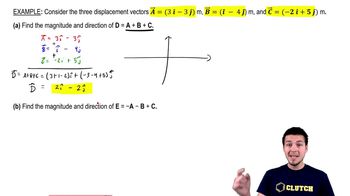
Adding 3 Vectors in Unit Vector Notation
7149
views
142
rank
2
comments
Guided course
05:58
Unit Vectors
9811
views
175
rank
Terms in this set (15)
Hide definitions
Unit Vectors
Vectors with a magnitude of one, used to simplify vector representation in the Cartesian coordinate system.
Magnitude
The length or size of a vector, often calculated using the Pythagorean theorem.
Direction
The orientation of a vector in space, often described using angles or unit vectors.
Cartesian Coordinate System
A coordinate system that specifies each point uniquely in a plane by a pair of numerical coordinates.
Vector Addition
The process of combining vectors by adding their corresponding components.
Components
The projections of a vector along the axes of a coordinate system, often expressed using unit vectors.
i, j, k Notation
A notation using unit vectors to represent vector components along the x, y, and z axes.
Resultant Vector
The vector sum of two or more vectors, representing the combined effect of the vectors.
Graphical Representation
A method of visualizing vectors using diagrams, often involving grid squares.
Trigonometric Functions
Functions like sine and cosine used to relate the angles and sides of a triangle.
Decomposition
The process of breaking a vector into its component parts along the coordinate axes.
Pythagorean Theorem
A mathematical equation relating the lengths of the sides of a right triangle.
Algebraic Representation
Expressing vectors using equations and unit vectors to specify components.
Tip to Tail Method
A method of vector addition where the tail of one vector is placed at the tip of another.
Negative Direction
The opposite direction along an axis, often indicated by a negative sign in vector notation.
 BackBack
 06:44
06:44
