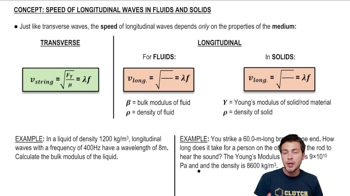
In which direction do longitudinal waves transfer energy relative to their wave motion?
Longitudinal waves transfer energy in the same direction as the wave motion, parallel to the direction of propagation.
What is an example of a longitudinal wave?
An example of a longitudinal wave is a sound wave.
When a sound wave travels through water, in what direction do the water particles move?
The water particles move back and forth parallel to the direction of the sound wave's propagation.
How does sound energy travel through a medium?
Sound energy travels by causing particles in the medium to oscillate parallel to the direction of wave propagation, transferring energy from one particle to the next.
Which types of waves require matter to carry energy?
Mechanical waves, such as longitudinal and transverse waves, require matter to carry energy.
What is the difference between a longitudinal wave and a transverse wave?
In longitudinal waves, particle oscillations are parallel to the direction of wave propagation, while in transverse waves, oscillations are perpendicular to the direction of propagation.
How do longitudinal and transverse waves differ in terms of particle motion?
Longitudinal waves have particle motion parallel to the direction of wave travel, while transverse waves have particle motion perpendicular to the direction of wave travel.
Does sound travel faster in warm air or cold air, and in humid air or dry air?
Sound travels faster in warm air than in cold air, and faster in humid air than in dry air, because both higher temperature and humidity decrease air density, increasing the speed of sound.
Can longitudinal waves be found in the sea?
Yes, longitudinal waves such as sound waves can travel through the sea (water).
What is an example of a compressional wave?
A sound wave is an example of a compressional (longitudinal) wave.
Is sound a transverse or longitudinal wave?
Sound is a longitudinal wave.
Which example contains only longitudinal waves?
A medium transmitting only sound waves contains only longitudinal waves.
What is an example of a longitudinal wave in everyday life?
An example of a longitudinal wave in everyday life is a sound wave traveling through air or water.
What type of wave can be demonstrated using a slinky?
A slinky can be used to demonstrate a longitudinal wave when compressions and rarefactions are created along its length.
Which of the following is an example of a longitudinal wave?
A sound wave is an example of a longitudinal wave.
What is true about longitudinal waves?
Longitudinal waves have particle oscillations parallel to the direction of wave propagation.
Which waves have oscillations parallel to their direction of motion?
Longitudinal waves have oscillations parallel to their direction of motion.
What happens to the particles of a medium when a sound wave passes through?
The particles of the medium oscillate back and forth parallel to the direction of the sound wave's travel.
How does sound travel through a medium?
Sound travels through a medium by causing its particles to oscillate parallel to the direction of wave propagation, transferring energy through compressions and rarefactions.
Which waves can travel through both solids and liquids?
Longitudinal waves, such as sound waves, can travel through both solids and liquids.
What phenomenon distinguishes longitudinal waves from transverse waves?
The direction of particle oscillation distinguishes longitudinal waves (parallel to propagation) from transverse waves (perpendicular to propagation).
How do the direction of vibration and the direction of motion compare in a longitudinal wave?
In a longitudinal wave, the direction of vibration of particles is parallel to the direction of wave motion.
How can you measure the amplitude of a longitudinal wave?
The amplitude of a longitudinal wave can be measured as the maximum displacement of particles from their equilibrium position during oscillation.
What best describes longitudinal waves?
Longitudinal waves are waves in which particle oscillations occur parallel to the direction of wave propagation.
In a longitudinal wave, how is energy moved relative to the direction of the wave's movement?
In a longitudinal wave, energy is moved parallel to the direction of the wave's movement.