Back

Velocity of Transverse Waves quiz #2

Control buttons has been changed to "navigation" mode.
1/16
  • What will change the velocity of a periodic wave on a string?

    Changing the tension or mass per unit length (μ) of the string will change the wave velocity.
  • What are the low points of a transverse wave called?

    The low points of a transverse wave are called troughs.
  • What is the main difference between transverse and longitudinal waves?

    Transverse waves oscillate perpendicular to propagation; longitudinal waves oscillate parallel to propagation.
  • What are the similarities between transverse and longitudinal waves?

    Both types transfer energy through a medium and have measurable properties such as speed, frequency, and wavelength.
  • Does the speed v of a wave depend on its frequency f according to v = λf?

    No, the speed v is determined by the medium's properties; v = λf shows the relationship between speed, wavelength, and frequency, but changing frequency alone does not change speed.
  • Does the speed v of a wave depend on its wavelength λ according to v = λf?

    No, the speed v is determined by the medium's properties; v = λf shows the relationship, but changing wavelength alone does not change speed.
  • How do you calculate the mass density (mu) of a string for use in the wave speed equation?

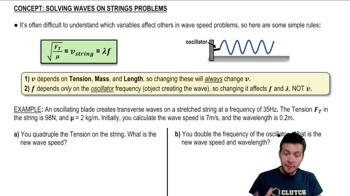
    The mass density mu is calculated by dividing the mass of the string by its length. This value is then used in the denominator of the wave speed equation for strings.
  • What happens to the wavelength of a wave on a string if the frequency of the oscillator is doubled while the wave speed remains constant?

    The wavelength is halved when the frequency is doubled, since wave speed equals wavelength times frequency. This is because the wave speed is determined by the string's properties and does not change with frequency.
  • If the tension in a string is quadrupled, by what factor does the wave speed change?

    The wave speed doubles when the tension is quadrupled. This is because wave speed is proportional to the square root of the tension.
  • Why might you need to use both the general wave speed equation and the string-specific wave speed equation to solve a problem involving waves on a string?

    You may need both equations because the general equation relates speed, wavelength, and frequency, while the string-specific equation allows you to calculate speed from physical properties like tension and mass density. This is necessary when not all variables are directly given.
  • What is the general formula for calculating the speed of a wave?

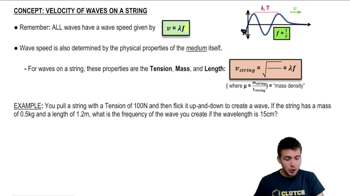
    The general formula for wave speed is v = λf, where v is the wave speed, λ (lambda) is the wavelength, and f is the frequency.
  • Which type of wave is not a transverse wave?

    A longitudinal wave is not a transverse wave. In longitudinal waves, particle motion is parallel to the direction of wave propagation, unlike transverse waves where particle motion is perpendicular.
  • What is the definition of wave speed in a medium?

    Wave speed is the rate at which a wave travels through a medium, determined by the physical properties of the medium and, for all waves, given by v = λf.
  • How can you determine the distance a wave travels in a given amount of time?

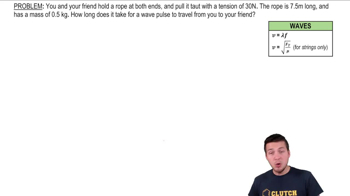
    The distance a wave travels in a given time is found by multiplying the wave speed by the time: distance = wave speed × time.
  • How do you calculate the speed of a transverse wave on a string?

    The speed of a transverse wave on a string is calculated using v = sqrt(T/μ), where T is the tension in the string and μ is the mass per unit length (mass density) of the string.
  • What are the two main equations used to find wave speed, and when is each used?

    The two main equations are v = λf, used for all waves, and v = sqrt(T/μ), used specifically for transverse waves on strings where T is tension and μ is mass per unit length.