Physics
My Course
Learn
Exam Prep
AI Tutor
Study Guides
Textbook Solutions
Flashcards
Explore
My Course
Learn
Exam Prep
AI Tutor
Study Guides
Textbook Solutions
Flashcards
Explore
Back
Velocity-Time Graphs & Acceleration definitions
You can tap to flip the card.
Velocity-Time Graph
You can tap to
flip the card.
👆
Velocity-Time Graph
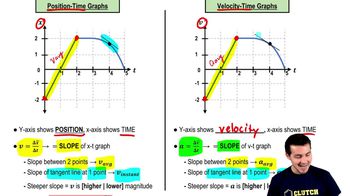
A graph with velocity on the y-axis and time on the x-axis, used to determine acceleration.
Track progress
Control buttons has been changed to "navigation" mode.
1/12
Related flashcards
Related practice
Recommended videos
Guided course
05:59
Velocity-Time Graphs & Acceleration
Patrick
12196
views
264
rank
4
comments
Terms in this set (12)
Hide definitions
Velocity-Time Graph
A graph with velocity on the y-axis and time on the x-axis, used to determine acceleration.
Acceleration
The slope of a velocity-time graph, indicating how velocity changes over time.
Slope
The measure of steepness of a line on a graph, representing acceleration in velocity-time graphs.
Average Acceleration
Calculated by the slope of a line connecting two points on a velocity-time graph.
Instantaneous Acceleration
The slope of the tangent line at a specific point on a velocity-time graph.
Tangent Line
A straight line that touches a curve at a single point, used to find instantaneous acceleration.
Steeper Slope
Indicates a greater magnitude of acceleration on a velocity-time graph.
Delta v
The change in velocity, used in calculating acceleration from a velocity-time graph.
Delta t
The change in time, used in calculating acceleration from a velocity-time graph.
Magnitude
The size or amount of acceleration, regardless of direction, indicated by slope steepness.
Negative Slope
Indicates negative acceleration, or deceleration, on a velocity-time graph.
Positive Slope
Indicates positive acceleration on a velocity-time graph.