Skip to main content
Physics
My Course
Learn
Exam Prep
AI Tutor
Study Guides
Textbook Solutions
Flashcards
Explore
Try the app
My Course
Learn
Exam Prep
AI Tutor
Study Guides
Textbook Solutions
Flashcards
Explore
Try the app
Back
Facts to mem Physics Chapter 27 & 28
You can tap to flip the card.
Symbol and unit for magnetic field
You can tap to flip the card.
👆
Symbol and unit for magnetic field
Magnetic field is represented by \(B\) and measured in teslas (T).
Track progress
Control buttons has been changed to "navigation" mode.
1/25
Recommended videos
Guided course
07:55
Find Zero Magnetic Field
6675
views
111
rank
2
comments
Guided course
12:33
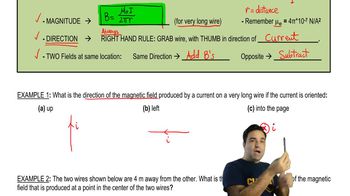
Magnetic Field Produced by Straight Currents
9658
views
138
rank
13
comments
Guided course
06:51
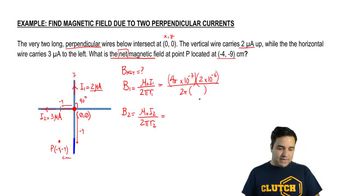
Find Field due to Two Perpendicular Currents
7173
views
103
rank
13
comments
Terms in this set (25)
Hide definitions
Symbol and unit for magnetic field
Magnetic field is represented by \(B\) and measured in teslas (T).
Symbol and unit for electric current
Electric current is represented by \(I\) and measured in amperes (A).
Number of loops and its unit
Number of loops is represented by \(N\) and is unitless.
Number of loops per length and its unit
Number of loops per length is represented by \(n\) and measured in inverse meters (1/m).
Permeability of free space symbol and value
Permeability of free space is \(\mu_0\) with value \(4\pi \times 10^{-7}~\mathrm{T \cdot m/A}\).
Magnetic force on a charged particle (vector form)
Force on a charged particle in a magnetic field is \(\mathbf{F_B} = q \mathbf{v} \times \mathbf{B}\).
Magnetic force on a charged particle (magnitude)
Magnitude of force is \(F_B = q v B \sin\theta\), where
θ
is angle between velocity and magnetic field.
Force on a current-carrying wire in a magnetic field (vector form)
Force on wire is \(\mathbf{F_B} = I \mathbf{L} \times \mathbf{B}\).
Force on a current-carrying wire in a magnetic field (magnitude)
Magnitude of force is \(F_B = I L B \sin\theta\), where
θ
is angle between wire and magnetic field.
Magnetic dipole moment of a wire loop
Magnetic dipole moment is \(\mu = I A\), where
A
is loop area.
Torque on a magnetic dipole in a magnetic field
Torque is \(\boldsymbol{\tau} = \boldsymbol{\mu} \times \mathbf{B}\).
Potential energy of a magnetic dipole in a magnetic field
Potential energy is \(U = - \boldsymbol{\mu} \cdot \mathbf{B}\).
Magnetic flux through a surface
Magnetic flux is \(\Phi_B = \int \mathbf{B} \cdot d\mathbf{A}\).
Magnetic field due to a long straight wire
Magnetic field strength is \(B = \frac{\mu_0 I}{2 \pi r}\), where
r
is distance from wire.
Direction of magnetic field around a long straight wire
Magnetic field forms circles around wire; use right hand with thumb in current direction and curled fingers show magnetic field direction.
Magnetic field at center of a wire loop
Magnetic field strength is \(B = \frac{N \mu_0 I}{2 a}\), where
a
is loop radius.
Direction of magnetic field at center of wire loop
Curl fingers in current direction; thumb points in direction of magnetic field at center.
Magnetic field inside a solenoid
Magnetic field strength is \(B = \mu_0 n I\), where \(n = \frac{N}{L}\) is loops per length.
Characteristic of magnetic field inside a solenoid
Magnetic field is approximately constant over the inner volume of the solenoid.
Force per unit length between two current-carrying wires
Force per length is \(\frac{F}{L} = \frac{\mu_0 I_1 I_2}{2 \pi r}\), where
r
is distance between wires.
When do two parallel current-carrying wires attract or repel?
Wires attract if currents flow in the same direction; repel if currents flow in opposite directions.
Ampere's Law equation
Ampere's Law is \(\oint \mathbf{B} \cdot d\mathbf{l} = \mu_0 I_{\text{enclosed}}\).
Determining sign of enclosed currents in Ampere's Law
Curl fingers in direction of \(d\mathbf{l}\); currents in thumb direction are positive, opposite are negative.
Equation explaining velocity selector operation
Velocity selector satisfies \(q E = q v B\), balancing electric and magnetic forces.
Equation used in mass spectrometer
Mass spectrometer relation is \(m v^2 / R = q v B\), relating mass, velocity, radius, charge, and magnetic field.
 BackBack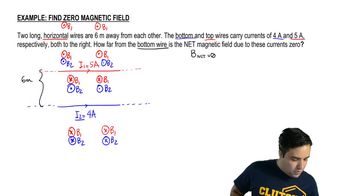
 07:55
07:55