Skip to main content
Physics
My Course
Learn
Exam Prep
AI Tutor
Study Guides
Textbook Solutions
Flashcards
Explore
Try the app
My Course
Learn
Exam Prep
AI Tutor
Study Guides
Textbook Solutions
Flashcards
Explore
Try the app
Back
Physics Chapter 23: Electric Potential and Energy
You can tap to flip the card.
Letter representing electric charge
You can tap to flip the card.
👆
Letter representing electric charge
Electric charge is represented by the letter \(q\) or \(Q\).
Track progress
Control buttons has been changed to "navigation" mode.
1/20
Recommended videos
Guided course
01:06
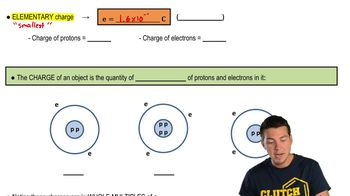
Charge of Atom
17393
views
465
rank
Guided course
05:37
Electric Charge
28171
views
885
rank
4
comments
Guided course
04:32
Electrons In Water (Using Density)
14822
views
297
rank
16
comments
Terms in this set (20)
Hide definitions
Letter representing electric charge
Electric charge is represented by the letter \(q\) or \(Q\).
SI unit of electric charge
Electric charge is measured in coulombs, abbreviated as
C
.
Letter representing electric field
Electric field is represented by the letter \(E\).
SI unit of electric field
Electric field is measured in newtons per coulomb (
NC
) or volts per meter (
Vm
).
Letter representing work
Work is represented by the letter \(W\).
SI unit of work
Work is measured in joules, abbreviated as
J
.
Letter representing electric potential energy
Electric potential energy is represented by the letter \(U\).
SI unit of electric potential energy
Electric potential energy is measured in joules (
J
).
Letter representing electric potential
Electric potential is represented by the letter \(V\).
SI unit of electric potential
Electric potential is measured in volts, abbreviated as
V
.
Equation relating work done by a conservative force to potential energy
\(W = -\Delta U\) defines the work done by a conservative force as the negative change in potential energy.
Equation for electric potential energy of two point charges
\(U = \frac{1}{4 \pi \epsilon_0} \frac{q_1 q_2}{r}\) gives the electric potential energy between two point charges.
Equation for electric potential due to a point charge
\(V(P) = \frac{1}{4 \pi \epsilon_0} \frac{q}{r}\) defines the electric potential at point P due to a point charge q.
Reference point where electric potential is zero for point charges
Electric potential \(V = 0\) is defined at infinite distance: \(V_r = 0 \text{ as } r \to \infty\).
Equation to determine electric potential from electric field
\(\Delta V = V_{final} - V_{initial} = - \int_{initial}^{final} \vec{E} \cdot d\vec{l}\) relates electric potential difference to the electric field.
Equation to determine electric field from electric potential
\(E_x = -\frac{\partial V}{\partial x}\) gives the electric field component from the spatial derivative of electric potential.
Relation between electric field and potential gradient
\(\vec{E} = - \nabla V\) shows that electric field is the negative gradient of electric potential.
Equation relating change in electric potential energy to change in electric potential
\(\Delta U = q \Delta V\) relates the change in electric potential energy to the charge and change in potential.
Equation defining kinetic energy of a particle
\(K = \frac{1}{2} m v^2\) defines the kinetic energy of a particle with mass m and speed v.
Conservation of energy equation including electric potential energy
\(K_A + U_A = K_B + U_B \quad \text{with} \quad U = qV\) expresses conservation of mechanical energy including electric potential energy.
 BackBack
 01:06
01:06