Back

Physics Chapter 25 & 26 Key Concepts and Equations

Control buttons has been changed to "navigation" mode.
1/27
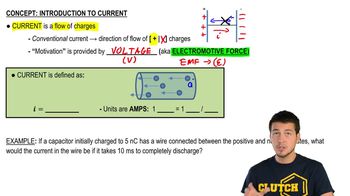
  • What letter represents electric current and its SI unit?

    Electric current is represented by \(I\) and measured in amperes (A).
  • What is current density and its symbol and unit?

    Current density is represented by \(J\) and measured in amperes per square meter (A/m²).
  • What symbol represents conductivity and its SI unit?

    Conductivity is represented by \(\sigma\) and measured in siemens per meter (S/m) or 1/(Ω·m).
  • What symbol represents resistivity and its SI unit?

    Resistivity is represented by \(\rho\) and measured in ohm meters (Ω·m).
  • What letter represents resistance and its SI unit?

    Resistance is represented by \(R\) and measured in ohms (Ω).
  • Equation relating drift velocity v_d to electric field E

    \(v_d = \frac{q \tau}{m} E\), where q is charge, τ is mean free time, and m is mass.
  • Equation relating current density J to drift velocity v_d

    \(J = nq v_d\), where n is charge carrier density and q is charge.
  • Equation relating current density J to conductivity σ and electric field E

    \(J = \sigma E\).
  • Equation relating current density J to resistivity \(\rho\) and electric field E

    \(J = \frac{1}{\rho} E\).
  • Equation relating current I to current density J and cross-sectional area A

    \(I = J \cdot A\).
  • Equation relating current I to charge Q and time t

    \(I = \frac{dQ}{dt}\).
  • Equation defining resistance R of a wire based on geometry

    \(R = \rho \frac{L}{A}\), where L is length and A is cross-sectional area.
  • Ohm's Law equation relating voltage V, current I, and resistance R

    \(V = RI\).
  • Formulas for power P used by a circuit element

    Power can be calculated as \(P = VI\), \(P = RI^2\), or \(P = \frac{V^2}{R}\).
  • Equation relating battery terminal voltage V_{ab}, emf E, current I, and internal resistance r

    \(V_{ab} = E - Ir\).
  • What letter represents voltage and its SI unit?

    Voltage is represented by \(V\) and measured in volts (V).
  • What letter represents charge on a capacitor and its SI unit?

    Charge on a capacitor is represented by \(Q\) and measured in coulombs (C).
  • Rules for resistors in series: equivalent resistance, current, and voltage

    1. Equivalent resistance: \(R_{eq} = R_1 + R_2 + R_3 + \dots\)
    2. Currents: \(I_{tot} = I_1 = I_2 = I_3 = \dots\)
    3. Voltage drops: \(V_{tot} = V_1 + V_2 + V_3 + \dots\)
  • Rules for resistors in parallel: equivalent resistance, current, and voltage

    1. Equivalent resistance: \(\frac{1}{R_{eq}} = \frac{1}{R_1} + \frac{1}{R_2} + \frac{1}{R_3} + \dots\)
    2. Currents: \(I_{tot} = I_1 + I_2 + I_3 + \dots\)
    3. Voltage drops: \(V_{tot} = V_1 = V_2 = V_3 = \dots\)
  • Kirchhoff's Junction Rule

    The sum of currents entering a junction equals zero: \(\sum I_i = 0\).
  • Kirchhoff's Loop Rule

    The sum of potential changes around any closed loop is zero: \(\sum \Delta V_i = 0\).
  • Potential drop over a resistor moving in direction of current

    \(\Delta V = -RI\).
  • Potential rise over a battery moving from negative to positive terminal

    \(\Delta V = +E\).
  • Maximum current in an RC circuit

    \(I_0 = \frac{\varepsilon}{R}\), where ε is emf and R is resistance.
  • Maximum charge on a capacitor in an RC circuit

    \(Q_0 = EC\), where E is emf and C is capacitance.
  • Percentage increase of a value in an RC circuit after one time constant t=\(\tau\)

    Value increases from 0% to 63% after one time constant.
  • Percentage decrease of a value in an RC circuit after one time constant t=\(\tau\)

    Value decreases from 100% to 37% after one time constant.