 Back
BackTemperature, Heat, and Thermal Expansion
 04:54
04:54
Terms in this set (20)
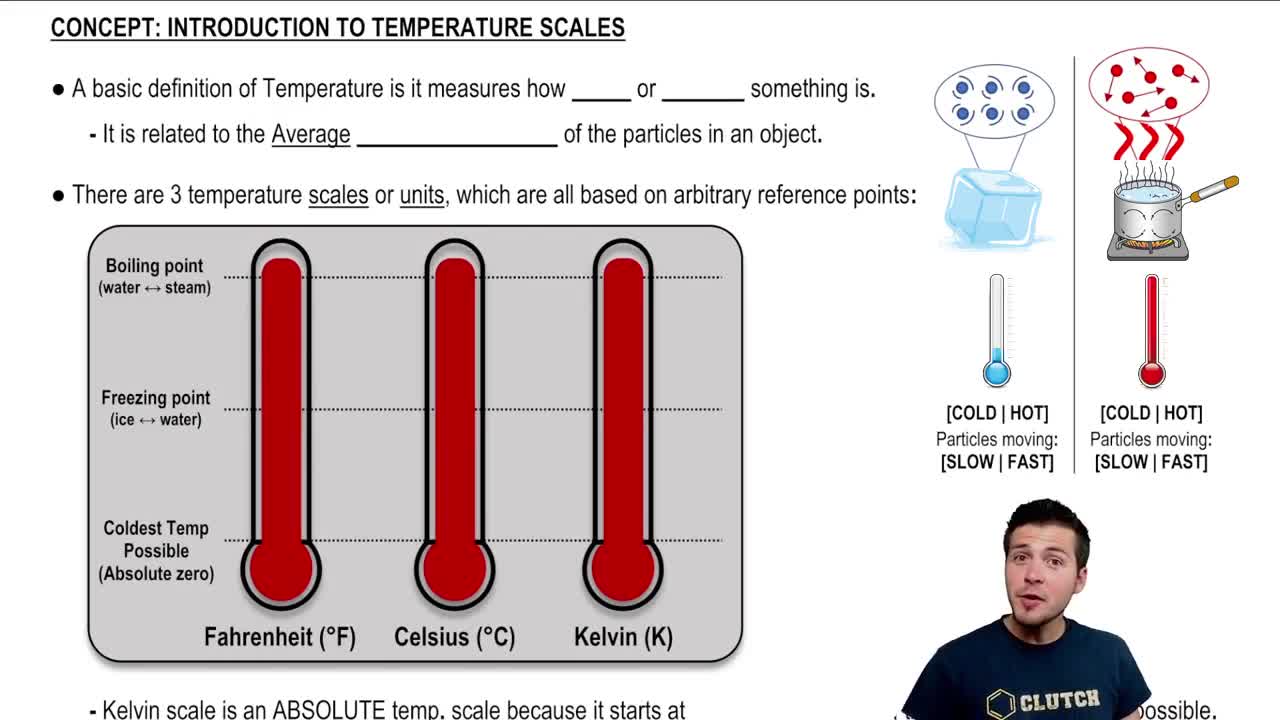
Temperature is a measure of the warmth or coldness of an object, proportional to the average translational kinetic energy per particle in a substance.
In gases, temperature reflects how fast particles bounce; in liquids, how fast they slide and jiggle; in solids, how fast they vibrate in place.
By the expansion or contraction of a liquid (mercury or alcohol) until thermal equilibrium is reached with the object.
Heat is internal energy transferred between objects due to a temperature difference, flowing from higher to lower temperature until equilibrium.
Temperature is average kinetic energy per particle; thermal energy depends on total kinetic energy and amount of substance.
Heat is measured in joules or calories; 4.19 joules equals 1 calorie.
Specific heat capacity is the heat required to raise the temperature of 1 gram of a substance by 1ºC, indicating thermal inertia.
Water absorbs energy in various ways, including molecular vibrations and rotations, allowing it to store more heat without large temperature changes.
Water's high specific heat moderates climate by storing and releasing heat slowly, influencing coastal temperatures and weather patterns.
When temperature rises, molecules jiggle faster and move farther apart, causing most substances to expand.
Railroad tracks expand due to heat; if expansion joints are insufficient, the tracks can buckle.
A strip of two metals with different expansion rates that bends with temperature changes, used in thermostats and switches.
Because lines expand and sag in heat; without slack, they may snap in cold when contracting.
Liquids generally expand more than solids when heated.
Ice forms open-structured crystals that increase volume, making ice less dense than liquid water.
Water contracts as ice crystals collapse until 4ºC, then expands as molecular motion increases.
Because ice is less dense than water due to its expanded crystal structure.
The state when two objects in contact reach the same average kinetic energy per particle and no net heat flows.
Heat flows spontaneously from the higher temperature object to the lower temperature one until equilibrium.
The amount of heat needed to raise the temperature of 1 gram of water by 1ºC, equal to 4.19 joules.