Ch 02: Kinematics in One Dimension
Knight Calc - Physics for Scientists and Engineers 5th Edition
Knight Calc5th EditionPhysics for Scientists and EngineersISBN: 9780137344796Not the one you use?Change textbook
Chapter 2, Problem 20b

Ball bearings are made by letting spherical drops of molten metal fall inside a tall tower—called a shot tower—and solidify as they fall. What is the bearing's impact velocity?

Verified step by step guidance
1
Identify the key variables: The problem involves free fall motion, so we need the height of the tower (h) and the acceleration due to gravity (g = 9.8 m/s²). The initial velocity (u) is 0 m/s since the ball bearings are dropped from rest.
Use the kinematic equation for velocity in free fall: v=2gh. This equation relates the final velocity (v) to the height (h) and gravitational acceleration (g).
Substitute the known values into the equation: Replace g with 9.8 m/s² and h with the given height of the tower (you'll need the specific height value to proceed).
Simplify the expression under the square root: Perform the multiplication of 2, g, and h to find the value inside the square root.
Take the square root of the result to calculate the final velocity (v). This will give you the impact velocity of the ball bearing when it reaches the ground.

Verified video answer for a similar problem:

This video solution was recommended by our tutors as helpful for the problem above.
Video duration:
3m
Was this helpful?

Key Concepts

Here are the essential concepts you must grasp in order to answer the question correctly.

Free Fall

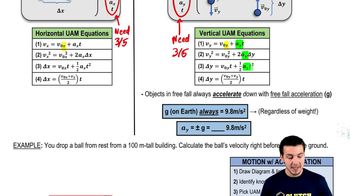
Free fall refers to the motion of an object under the influence of gravity alone, without any air resistance. In the context of the shot tower, the molten metal drops fall freely from a height, accelerating downwards due to gravitational force. The impact velocity can be calculated using the equations of motion for free-falling objects.
Recommended video:
Guided course
08:36
Vertical Motion & Free Fall

Kinematic Equations

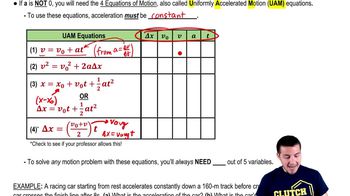
Kinematic equations describe the relationship between an object's displacement, initial velocity, final velocity, acceleration, and time. For an object in free fall, the relevant equation to find the final velocity just before impact is v = u + at, where 'u' is the initial velocity (zero for a drop), 'a' is the acceleration due to gravity, and 't' is the time of fall.
Recommended video:
Guided course
08:25
Kinematics Equations

Impact Velocity

Impact velocity is the speed of an object just before it collides with another object or surface. It is influenced by the height from which the object falls and the acceleration due to gravity. In this scenario, calculating the impact velocity of the molten metal involves determining how fast it is moving just before it solidifies upon hitting the ground.
Recommended video:
Guided course
7:27
Escape Velocity
Related Practice
Textbook Question

Write a short description of the motion of a real object for which FIGURE EX1.20 would be a realistic position-versus-time graph.

1187
views

Textbook Question

FIGURE EX1.18 shows the motion diagram of a drag racer. The camera took one frame every 2 s. Make a position-versus-time graph for the drag racer. Because you have data only at certain instants, your graph should consist of dots that are not connected together.

1261
views
Textbook Question

When jumping, a flea accelerates at an astounding 1000 m/s2, but over only the very short distance of 0.50 mm. If a flea jumps straight up, and if air resistance is neglected (a rather poor approximation in this situation), how high does the flea go?

4552
views
1
rank
1
comments
Textbook Question

As a science project, you drop a watermelon off the top of the Empire State Building, 320 m above the sidewalk. It so happens that Superman flies by at the instant you release the watermelon. Superman is headed straight down with a speed of 35 m/s. How fast is the watermelon going when it passes Superman?

4152
views
Textbook Question

A rock is tossed straight up from ground level with a speed of 20 m/s. When it returns, it falls into a hole 10 m deep. What is the rock's speed as it hits the bottom of the hole?

3948
views
Textbook Question

Ball bearings are made by letting spherical drops of molten metal fall inside a tall tower—called a shot tower—and solidify as they fall. If a bearing needs 4.0 s to solidify enough for impact, how high must the tower be?

2873
views