Ch 03: Vectors and Coordinate Systems
Knight Calc - Physics for Scientists and Engineers 5th Edition
Knight Calc5th EditionPhysics for Scientists and EngineersISBN: 9780137344796Not the one you use?Change textbook
Chapter 3, Problem 35b

Jack and Jill ran up the hill at 3.0 m/s. The horizontal component of Jill's velocity vector was 2.5 m/s. What was the vertical component of Jill's velocity?

Verified step by step guidance
1
Identify the given values: The magnitude of Jill's velocity vector is 3.0 m/s, and the horizontal component of her velocity is 2.5 m/s.
Recall the Pythagorean theorem, which relates the components of a velocity vector to its magnitude: \( v^2 = v_x^2 + v_y^2 \), where \( v \) is the magnitude of the velocity, \( v_x \) is the horizontal component, and \( v_y \) is the vertical component.
Rearrange the equation to solve for the vertical component \( v_y \): \( v_y = \sqrt{v^2 - v_x^2} \).
Substitute the given values into the equation: \( v_y = \sqrt{(3.0 \ \text{m/s})^2 - (2.5 \ \text{m/s})^2} \).
Simplify the expression under the square root to find the vertical component of Jill's velocity.

Verified video answer for a similar problem:

This video solution was recommended by our tutors as helpful for the problem above.
Video duration:
4m
Was this helpful?

Key Concepts

Here are the essential concepts you must grasp in order to answer the question correctly.

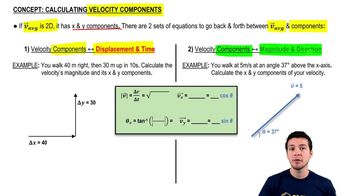
Velocity Components

Velocity is a vector quantity that has both magnitude and direction. In two-dimensional motion, the velocity can be broken down into horizontal and vertical components. The horizontal component represents motion along the x-axis, while the vertical component represents motion along the y-axis. Understanding these components is essential for analyzing motion in different directions.
Recommended video:
Guided course
05:53
Calculating Velocity Components

Pythagorean Theorem

The Pythagorean Theorem is a fundamental principle in geometry that relates the lengths of the sides of a right triangle. It states that the square of the hypotenuse (the side opposite the right angle) is equal to the sum of the squares of the other two sides. In the context of velocity, this theorem is used to calculate the resultant velocity when both horizontal and vertical components are known.
Recommended video:
Guided course
13:46
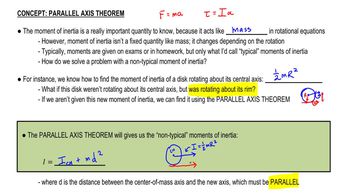
Parallel Axis Theorem

Trigonometric Functions

Trigonometric functions, such as sine and cosine, relate the angles of a triangle to the ratios of its sides. In physics, these functions are often used to resolve vectors into their components. For example, the sine function can be used to find the vertical component of a velocity vector when the angle and the magnitude of the vector are known, which is crucial for solving problems involving inclined motion.
Recommended video:
Guided course
08:30
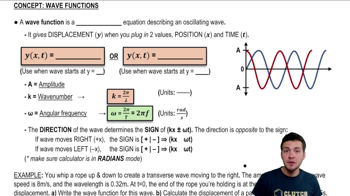
Intro to Wave Functions
Related Practice
Textbook Question

A jet plane taking off from an aircraft carrier has acceleration a = ( 15 m/s², 22° above horizontal). What are the horizontal and vertical components of the jet's acceleration?

2503
views

Textbook Question

Jack and Jill ran up the hill at 3.0 m/s. The horizontal component of Jill's velocity vector was 2.5 m/s. What was the angle of the hill?

1882
views
Textbook Question

Kami is walking through the airport with her two-wheeled suitcase. The suitcase handle is tilted 40° from vertical, and Kami pulls parallel to the handle with a force of 120 N. (Force is measured in newtons, abbreviated N.) What are the horizontal and vertical components of her applied force?

1768
views
Textbook Question

A cannonball leaves the barrel with velocity v = (75î + 45ĵ). At what angle is the barrel tilted above horizontal?

2273
views
Textbook Question

Your neighbor Paul has rented a truck with a loading ramp. The ramp is tilted upward at 25°, and Paul is pulling a large crate up the ramp with a rope that angles 10° above the ramp. If Paul pulls with a force of 550 N, what are the horizontal and vertical components of his force? (Force is measured in newtons, abbreviated N.)

2379
views
Textbook Question

You are fixing the roof of your house when a hammer breaks loose and slides down. The roof makes an angle of 35° with the horizontal, and the hammer is moving at 4.5 m/s when it reaches the edge. What are the horizontal and vertical components of the hammer's velocity just as it leaves the roof?

2187
views