
Ch 06: Dynamics I: Motion Along a Line
Knight Calc - Physics for Scientists and Engineers 5th Edition
Knight Calc5th EditionPhysics for Scientists and EngineersISBN: 9780137344796Not the one you use?Change textbook
Chapter 6, Problem 47b

The motor of a 350 g model rocket generates 9.5 N thrust. If air resistance can be neglected, what will be the rocket's speed as it reaches a height of 85 m?

Verified step by step guidance
1
Step 1: Identify the given values and relevant equations. The mass of the rocket is 350 g (convert to kilograms: 0.350 kg), the thrust force is 9.5 N, and the height reached is 85 m. Use the work-energy principle to solve the problem, where the work done by the thrust force is converted into the rocket's kinetic energy.
Step 2: Calculate the net force acting on the rocket. Since air resistance is neglected, the net force is the thrust minus the gravitational force. Gravitational force is given by \( F_g = m \cdot g \), where \( g \) is the acceleration due to gravity (\( 9.8 \, \text{m/s}^2 \)). Subtract \( F_g \) from the thrust to find the net force.
Step 3: Determine the work done by the net force. Work is calculated using \( W = F_{\text{net}} \cdot d \), where \( F_{\text{net}} \) is the net force and \( d \) is the distance (height) the rocket travels, which is 85 m.
Step 4: Relate the work done to the kinetic energy of the rocket. The work-energy theorem states that \( W = \Delta KE \), where \( \Delta KE \) is the change in kinetic energy. Since the rocket starts from rest, its initial kinetic energy is zero, and \( \Delta KE = \frac{1}{2} m v^2 \). Solve for \( v \) (the rocket's speed) using \( v = \sqrt{\frac{2W}{m}} \).
Step 5: Substitute the values for \( W \) and \( m \) into the equation \( v = \sqrt{\frac{2W}{m}} \) to find the rocket's speed. Ensure all units are consistent (e.g., mass in kilograms, distance in meters, force in newtons) before performing the calculation.

Verified video answer for a similar problem:

This video solution was recommended by our tutors as helpful for the problem above.
Video duration:
8m
Was this helpful?

Key Concepts

Here are the essential concepts you must grasp in order to answer the question correctly.

Newton's Second Law of Motion

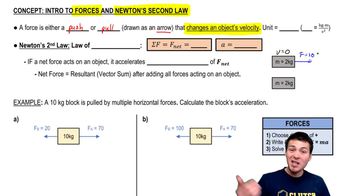
Newton's Second Law states that the acceleration of an object is directly proportional to the net force acting on it and inversely proportional to its mass. This principle can be expressed with the formula F = ma, where F is the net force, m is the mass, and a is the acceleration. In the context of the rocket, the thrust generated by the motor provides the net force that will accelerate the rocket upwards.
Recommended video:
Guided course
06:54
Intro to Forces & Newton's Second Law

Kinematic Equations

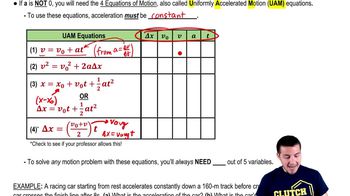
Kinematic equations describe the motion of objects under constant acceleration. They relate displacement, initial velocity, final velocity, acceleration, and time. For the rocket's ascent, we can use these equations to determine the final speed at a specific height, taking into account the initial conditions and the acceleration due to the thrust.
Recommended video:
Guided course
08:25
Kinematics Equations

Conservation of Energy

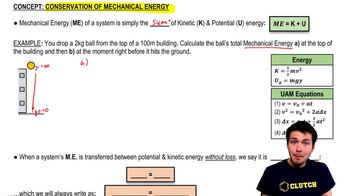
The principle of conservation of energy states that energy cannot be created or destroyed, only transformed from one form to another. In the case of the rocket, the work done by the thrust converts chemical energy from the fuel into kinetic energy and gravitational potential energy as the rocket ascends. At the maximum height, the kinetic energy will be converted into potential energy, allowing us to analyze the rocket's speed at that height.
Recommended video:
Guided course
06:24
Conservation Of Mechanical Energy
Related Practice
Textbook Question

Sam, whose mass is 75 kg, takes off across level snow on his jet-powered skis. The skis have a thrust of 200 N and a coefficient of kinetic friction on snow of 0.10. Unfortunately, the skis run out of fuel after only 10 s. What is Sam's top speed?

2488
views
Textbook Question

A rocket of mass m is launched straight up with thrust Fthrust. Find an expression for the rocket's speed at height h if air resistance is neglected.

1516
views
Textbook Question

Compressed air is used to fire a 50 g ball vertically upward from a 1.0-m-tall tube. The air exerts an upward force of 2.0 N on the ball as long as it is in the tube. How high does the ball go above the top of the tube? Neglect air resistance.

1862
views
Textbook Question

A baggage handler drops your 10 kg suitcase onto a conveyor belt running at 2.0 m/s. The materials are such that μs = 0.50 and μk = 0.30. How far is your suitcase dragged before it is riding smoothly on the belt?

1745
views
Textbook Question

A rifle with a barrel length of 60 cm fires a 10 g bullet with a horizontal speed of 400 m/s. The bullet strikes a block of wood and penetrates to a depth of 12 cm. How long does it take the bullet to come to rest?

2159
views
Textbook Question

Sam, whose mass is 75 kg, takes off across level snow on his jet-powered skis. The skis have a thrust of 200 N and a coefficient of kinetic friction on snow of 0.10. Unfortunately, the skis run out of fuel after only 10 s. How far has Sam traveled when he finally coasts to a stop?

589
views