
Ch 08: Dynamics II: Motion in a Plane
Knight Calc - Physics for Scientists and Engineers 5th Edition
Knight Calc5th EditionPhysics for Scientists and EngineersISBN: 9780137344796Not the one you use?Change textbook
Chapter 8, Problem 35

A motorcycle daredevil plans to ride up a 2.0-m-high, 20° ramp, sail across a 10-m-wide pool filled with hungry crocodiles, and land at ground level on the other side. He has done this stunt many times and approaches it with confidence. Unfortunately, the motorcycle engine dies just as he starts up the ramp. He is going 11 m/s at that instant, and the rolling friction of his rubber tires (coefficient 0.02) is not negligible. Does he survive, or does he become crocodile food? Justify your answer by calculating the distance he travels through the air after leaving the end of the ramp.

Verified step by step guidance
1
Step 1: Break the problem into two parts: (a) the motion of the motorcycle on the ramp and (b) the projectile motion after leaving the ramp. Start by analyzing the motion on the ramp. Use the work-energy principle to determine the velocity of the motorcycle at the top of the ramp. Account for the effects of rolling friction and gravitational potential energy.
Step 2: Calculate the work done against rolling friction as the motorcycle moves up the ramp. The force of rolling friction is given by \( F_{friction} = \mu \cdot m \cdot g \cdot \cos(\theta) \), where \( \mu \) is the coefficient of rolling friction, \( m \) is the mass of the motorcycle and rider, \( g \) is the acceleration due to gravity, and \( \theta \) is the angle of the ramp. The work done is \( W_{friction} = F_{friction} \cdot d \), where \( d \) is the length of the ramp.
Step 3: Determine the gravitational potential energy gained by the motorcycle as it ascends the ramp. This is given by \( U = m \cdot g \cdot h \), where \( h \) is the height of the ramp (2.0 m). Subtract the work done against friction and the potential energy from the initial kinetic energy \( KE = \frac{1}{2} m v^2 \) to find the remaining kinetic energy at the top of the ramp.
Step 4: Use the remaining kinetic energy at the top of the ramp to calculate the velocity of the motorcycle as it leaves the ramp. The velocity components can be broken into horizontal and vertical components using trigonometry: \( v_x = v \cdot \cos(\theta) \) and \( v_y = v \cdot \sin(\theta) \).
Step 5: Analyze the projectile motion of the motorcycle. Use the vertical motion equation \( y = v_y t - \frac{1}{2} g t^2 \) to find the time of flight, where \( y \) is the vertical displacement (0 m since it lands at ground level). Then, use the horizontal motion equation \( x = v_x t \) to calculate the horizontal distance traveled. Compare this distance to the width of the pool (10 m) to determine if the daredevil survives.

Verified video answer for a similar problem:

This video solution was recommended by our tutors as helpful for the problem above.
Was this helpful?

Key Concepts

Here are the essential concepts you must grasp in order to answer the question correctly.

Kinematics

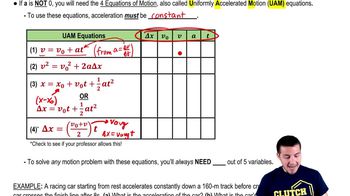
Kinematics is the branch of mechanics that deals with the motion of objects without considering the forces that cause the motion. It involves concepts such as displacement, velocity, and acceleration. In this scenario, understanding the initial velocity of the motorcycle and how it affects the trajectory after leaving the ramp is crucial for calculating the distance traveled through the air.
Recommended video:
Guided course
08:25
Kinematics Equations

Projectile Motion

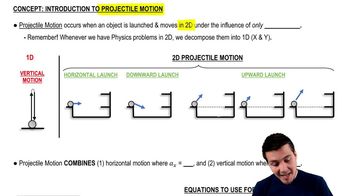
Projectile motion refers to the motion of an object that is thrown or projected into the air, subject only to the acceleration of gravity. This concept is essential for analyzing the motorcycle's flight after it leaves the ramp. The horizontal and vertical components of the motion can be treated separately, allowing for the calculation of the time of flight and horizontal distance traveled.
Recommended video:
Guided course
04:44
Introduction to Projectile Motion

Energy Conservation

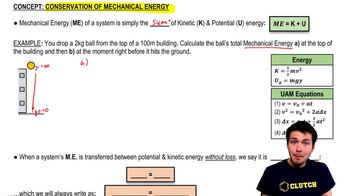
The principle of energy conservation states that energy cannot be created or destroyed, only transformed from one form to another. In this context, the motorcycle's initial kinetic energy and potential energy at the top of the ramp must be considered. The energy lost due to rolling friction will also affect the motorcycle's speed and distance traveled, making it vital to account for these energy transformations in the calculations.
Recommended video:
Guided course
06:24
Conservation Of Mechanical Energy
Related Practice
Textbook Question

CALC A 100 g bead slides along a frictionless wire with the parabolic shape y = (2m-1) x2. Find an expression for ay, the vertical component of acceleration, in terms of x, vx, and ax. Hint: Use the basic definitions of velocity and acceleration.

2294
views
Textbook Question

A 2.0 kg projectile with initial velocity v = 8.0 î m/s experiences the variable force F = -2.0t î + 4.0t² ĵ N, where t is in s. What is the projectile's speed at t = 2.0 s?

448
views
Textbook Question

A 250 g ball is launched with a speed of 35 m/s at a 30° angle. A strong headwind exerts a constant horizontal drag force on the ball. What is the magnitude of the drag force if the wind reduces the ball's travel distance by 20%?

1760
views
Textbook Question

A car can just barely turn a corner on an unbanked road at 45 km/h on a dry sunny day. What is the car's maximum cornering speed on a rainy day when the coefficient of static friction has been reduced by 50%?

2661
views
3
rank
Textbook Question

A 75 kg man weighs himself at the north pole and at the equator. Which scale reading is higher? By how much? Assume the earth is spherical.

268
views
Textbook Question

An 85,000 kg stunt plane performs a loop-the-loop, flying in a 260-m-diameter vertical circle. At the point where the plane is flying straight down, its speed is 55 m/s and it is speeding up at a rate of 12 m/s per second. What angle does the net force make with the horizontal? Let an angle above horizontal be positive and an angle below horizontal be negative.

1846
views