Ch 18: A Macroscopic Description of Matter
Knight Calc - Physics for Scientists and Engineers 5th Edition
Knight Calc5th EditionPhysics for Scientists and EngineersISBN: 9780137344796Not the one you use?Change textbook
Chapter 18, Problem 21b

A gas at 100°C fills volume V₀. If the pressure is held constant, what is the volume if the Kelvin temperature is doubled?

Verified step by step guidance
1
Step 1: Understand the relationship between temperature and volume for a gas at constant pressure. This is described by Charles's Law, which states that the volume of a gas is directly proportional to its absolute temperature (Kelvin) when pressure is constant. Mathematically, Charles's Law can be expressed as: VT = V₀T₀, where V is the final volume, T is the final temperature, V₀ is the initial volume, and T₀ is the initial temperature.
Step 2: Convert the given temperature from Celsius to Kelvin. The initial temperature is 100°C, and the Kelvin temperature is calculated using the formula: T₀ = 100 + 273.15. This gives the initial temperature in Kelvin.
Step 3: Double the Kelvin temperature. If the initial Kelvin temperature is T₀, the final Kelvin temperature T is given by: T = 2T₀. This step ensures the temperature is doubled as per the problem statement.
Step 4: Use Charles's Law to find the final volume. Rearrange the formula to solve for V: V = V₀ × TT₀. Substitute the values of T and T₀ into the equation.
Step 5: Simplify the expression for V. Since T = 2T₀, the equation becomes: V = V₀ × 2. This shows that the final volume is twice the initial volume.

Verified video answer for a similar problem:

This video solution was recommended by our tutors as helpful for the problem above.
Video duration:
2m
Was this helpful?

Key Concepts

Here are the essential concepts you must grasp in order to answer the question correctly.

Ideal Gas Law

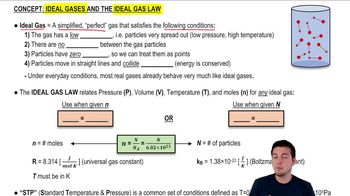
The Ideal Gas Law relates the pressure, volume, temperature, and number of moles of an ideal gas through the equation PV = nRT. This law is fundamental in understanding how gases behave under varying conditions of temperature and pressure, allowing us to predict changes in volume when temperature changes.
Recommended video:
Guided course
07:21
Ideal Gases and the Ideal Gas Law

Temperature Scales

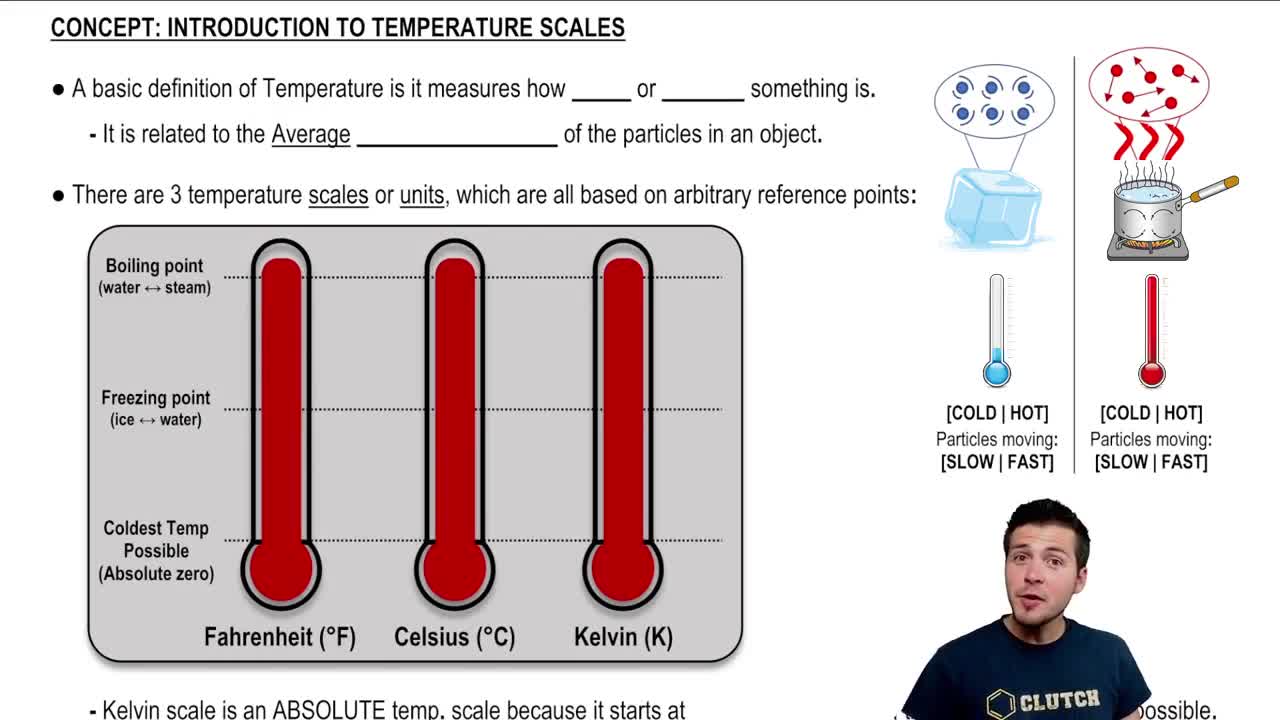
Temperature can be measured in different scales, with Celsius and Kelvin being the most common in physics. The Kelvin scale is an absolute temperature scale where 0 K represents absolute zero, the point at which molecular motion ceases. To convert Celsius to Kelvin, one adds 273.15, making it crucial to use Kelvin when applying gas laws.
Recommended video:
Guided course
04:54
Introduction To Temperature Scales

Charles's Law

Charles's Law states that the volume of a gas is directly proportional to its absolute temperature when pressure is held constant. This means that if the temperature of a gas increases, its volume will also increase, provided the pressure does not change. This principle is essential for solving problems involving changes in gas volume with temperature variations.
Recommended video:
Related Practice
Textbook Question

A cylinder contains nitrogen gas. A piston compresses the gas to half its initial volume. Afterward, has the mass density of the gas changed? If so, by what factor? If not, why not?

1549
views

Textbook Question

A gas at 100°C fills volume V0. If the pressure is held constant, what is the volume if the Celsius temperature is doubled?

1617
views
Textbook Question

The total lung capacity of a typical adult is 5.0 L. Approximately 20% of the air is oxygen. At sea level and at a body temperature of 37°C, how many oxygen molecules do the lungs contain at the end of a strong inhalation?

2776
views
Textbook Question

A 20-cm-diameter cylinder that is 40 cm long contains 50 g of oxygen gas at 20°C. What is the number density of the oxygen?

1618
views
1
rank
Textbook Question
Common outdoor thermometers are filled with red-colored ethyl alcohol. One thermometer has a 0.40-mm-diameter capillary tube attached to a 9.0-mm-diameter spherical bulb. On a 0°C morning, the column of alcohol stands 30 mm above the bulb. What is the temperature in °C when the column of alcohol stands 130 mm above the bulb? The expansion of the glass is much less than that of the alcohol and can be ignored.
1761
views
1
rank
1
comments
Textbook Question

The solar corona is a very hot atmosphere surrounding the visible surface of the sun. X-ray emissions from the corona show that its temperature is about 2×10⁶ K. The gas pressure in the corona is about 0.03 Pa. Estimate the number density of particles in the solar corona.

2367
views