
Ch 20: The Micro/Macro Connection
Knight Calc - Physics for Scientists and Engineers 5th Edition
Knight Calc5th EditionPhysics for Scientists and EngineersISBN: 9780137344796Not the one you use?Change textbook
Chapter 20, Problem 40

A 75 g ice cube at 0℃ is placed on a very large table at 20℃. You can assume that the temperature of the table does not change. As the ice cube melts and then comes to thermal equilibrium, what are the entropy changes of (a) the water, (b) the table, and (c) the universe?

Verified step by step guidance
1
Step 1: Understand the problem. The ice cube at 0℃ will first melt into water at 0℃, then the resulting water will warm up to thermal equilibrium with the table at 20℃. The entropy changes for the water, the table, and the universe need to be calculated. Entropy change is given by ΔS = Q/T, where Q is the heat transferred and T is the temperature (in Kelvin).
Step 2: Calculate the heat required to melt the ice cube. The mass of the ice cube is 75 g (0.075 kg), and the latent heat of fusion for water is L_f = 334,000 J/kg. The heat required to melt the ice is Q_melt = m * L_f. This heat transfer occurs at a constant temperature of 0℃ (273 K).
Step 3: Calculate the heat required to warm the melted water from 0℃ to 20℃. The specific heat capacity of water is c = 4,186 J/(kg·K). The heat required to warm the water is Q_warm = m * c * ΔT, where ΔT = 20℃ - 0℃ = 20 K. This heat transfer occurs over a range of temperatures, so the entropy change for the water during this process is ΔS_warm = ∫(dQ/T), which can be approximated as ΔS_warm = Q_warm / T_avg, where T_avg is the average temperature in Kelvin during the warming process.
Step 4: Calculate the entropy change of the table. The table loses heat equal to the total heat gained by the ice cube and water (Q_total = Q_melt + Q_warm). The entropy change of the table is ΔS_table = -Q_total / T_table, where T_table is the constant temperature of the table (20℃ = 293 K). The negative sign indicates that the table loses entropy as it loses heat.
Step 5: Calculate the entropy change of the universe. The entropy change of the universe is the sum of the entropy changes of the water and the table: ΔS_universe = ΔS_water + ΔS_table. Since entropy is a state function, this value will indicate whether the process is irreversible (ΔS_universe > 0).

Verified video answer for a similar problem:

This video solution was recommended by our tutors as helpful for the problem above.
Video duration:
16m
Was this helpful?

Key Concepts

Here are the essential concepts you must grasp in order to answer the question correctly.

Entropy

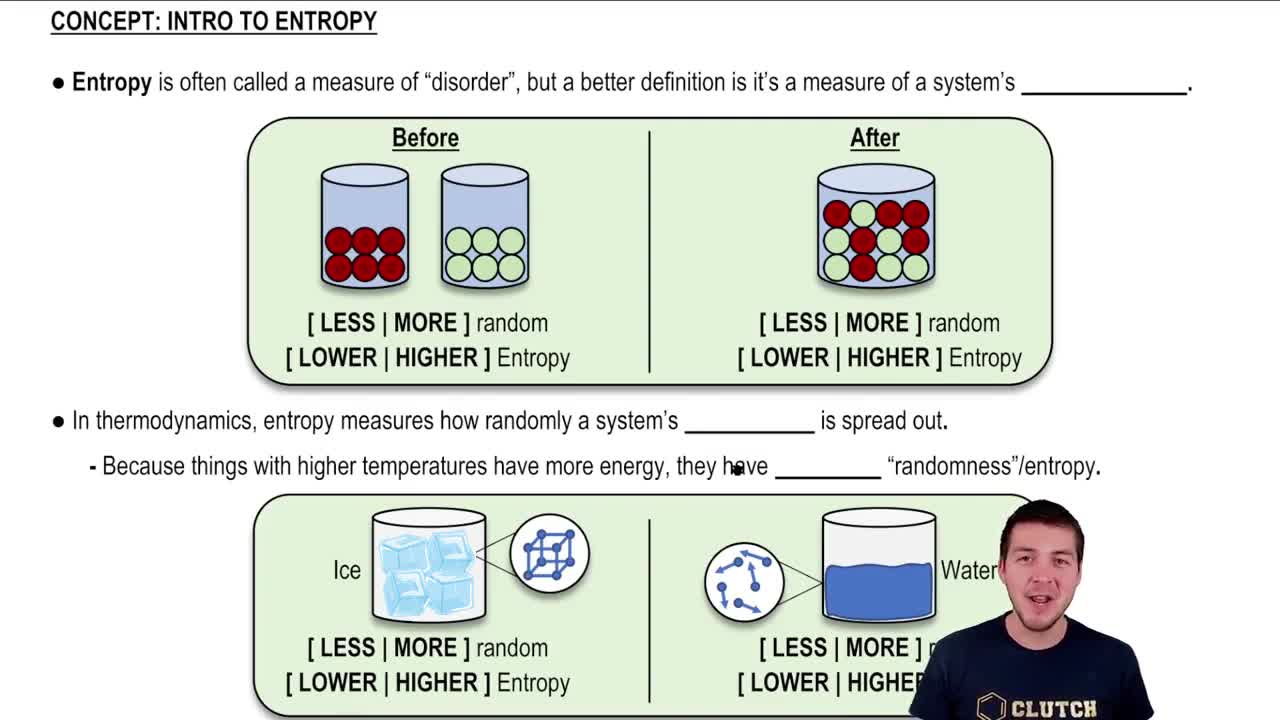
Entropy is a measure of the disorder or randomness in a system. In thermodynamics, it quantifies the amount of energy in a physical system that is not available to do work. When heat is transferred, such as from the table to the melting ice, the entropy of the system changes, reflecting the distribution of energy and the direction of spontaneous processes.
Recommended video:
Guided course
07:50
Intro to Entropy

Thermal Equilibrium

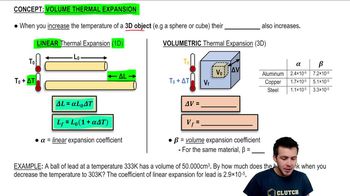
Thermal equilibrium occurs when two objects in thermal contact no longer exchange heat, meaning they are at the same temperature. In this scenario, the ice cube and the table will reach thermal equilibrium when the ice has completely melted and the resulting water has warmed to the table's temperature of 20℃. This concept is crucial for understanding how energy transfer affects the states of matter and entropy.
Recommended video:
Guided course
05:21
Volume Thermal Expansion

Heat Transfer and Phase Change

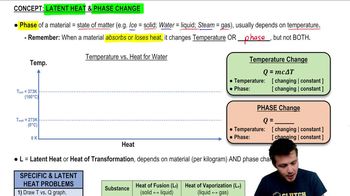
Heat transfer refers to the movement of thermal energy from one object to another, driven by a temperature difference. In this case, the heat from the table melts the ice cube, a phase change from solid to liquid, which requires energy (latent heat). Understanding the principles of heat transfer and phase changes is essential for calculating the changes in entropy for both the water and the table during this process.
Recommended video:
Guided course
10:40
Latent Heat & Phase Changes
Related Practice
Textbook Question

Your calculator can't handle enormous exponents, but we can make sense of large powers of e by converting them to large powers of 10. If we write e = 10α, then eβ = (10α)β = 10αβ. What is the multiplicity of a macrostate with entropy S = 1.0 J/K? Give your answer as a power of 10.

1163
views
Textbook Question

The vibrational modes of molecular nitrogen are 'frozen out' at room temperature but become active at temperatures above ≈1500 K. The temperature in the combustion chamber of a jet engine can reach 2000 K, so an engineering analysis of combustion requires knowing the thermal properties of materials at these temperatures. What is the expected specific heat ratio γ for nitrogen at 2000 K?

2367
views
Textbook Question

The pressure inside a tank of neon is 150 atm. The temperature is 25℃. On average, how many atomic diameters does a neon atom move between collisions?

320
views
Textbook Question

What is the entropy change of the nitrogen if 250 mL of liquid nitrogen boils away and then warms to 20℃ at constant pressure? The density of liquid nitrogen is 810 kg/m3.

1620
views
Textbook Question

2.0 mol of monatomic gas A initially has 5000 J of thermal energy. It interacts with 3.0 mol of monatomic gas B, which initially has 8000 J of thermal energy. Which gas has the higher initial temperature?

1760
views
Textbook Question

2.0 mol of helium at 280℃ undergo an isobaric process in which the helium entropy increases by 35 J/K. What is the final temperature of the gas?

1870
views