Ch 23: The Electric Field
Knight Calc - Physics for Scientists and Engineers 5th Edition
Knight Calc5th EditionPhysics for Scientists and EngineersISBN: 9780137344796Not the one you use?Change textbook
Chapter 23, Problem 47

A ring of radius R has total charge Q. At what distance along the z-axis is the electric field strength a maximum?

Verified step by step guidance
1
Step 1: Begin by understanding the setup of the problem. The ring of radius R is uniformly charged with a total charge Q. The electric field along the z-axis is due to the symmetry of the ring, and we aim to find the point along the z-axis where the electric field strength is maximized.
Step 2: Write the expression for the electric field along the z-axis due to a uniformly charged ring. The electric field at a distance z from the center of the ring is given by: E = k Q z ( R 2 + z 2 ) 3
Step 3: To find the maximum electric field strength, take the derivative of the electric field expression with respect to z and set it equal to zero. This will give the critical points where the electric field could be maximized. Use the chain rule and product rule for differentiation as needed.
Step 4: Solve the resulting equation from the derivative step to find the value of z. This involves algebraic manipulation and may require simplifying terms involving R and z. The solution will yield the distance z along the z-axis where the electric field strength is maximum.
Step 5: Verify that the value of z obtained corresponds to a maximum by checking the second derivative or analyzing the behavior of the electric field around the critical point. This ensures the solution is correct and corresponds to the maximum electric field strength.

Verified video answer for a similar problem:

This video solution was recommended by our tutors as helpful for the problem above.
Was this helpful?

Key Concepts

Here are the essential concepts you must grasp in order to answer the question correctly.

Electric Field

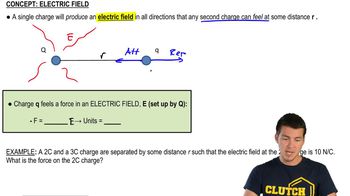
The electric field is a vector field that represents the force exerted by an electric charge on other charges in its vicinity. It is defined as the force per unit charge and is measured in newtons per coulomb (N/C). For a charged ring, the electric field varies with distance from the ring, and understanding its behavior is crucial for determining where it reaches a maximum along the z-axis.
Recommended video:
Guided course
03:16
Intro to Electric Fields

Symmetry in Charge Distribution

The symmetry of a charge distribution, such as a ring, plays a significant role in calculating the electric field. Due to the uniform distribution of charge along the ring, the electric field components in the radial direction cancel out, leaving only the axial component along the z-axis. This symmetry simplifies the analysis and helps identify the location where the electric field strength is maximized.
Recommended video:
Guided course
12:39
Solving Symmetric Launch Problems

Maximization Techniques

Maximization techniques involve finding the point at which a function reaches its highest value. In the context of the electric field of a charged ring, this typically requires taking the derivative of the electric field expression with respect to the distance along the z-axis and setting it to zero. Solving this equation provides the distance at which the electric field strength is maximized.
Recommended video:
Guided course
15:04
Intro to Torque
Related Practice
Textbook Question

CALC A uniform electric field’s strength is increasing with time as E=(1.5×10⁴+(5.0×10¹⁰s1)t)N/CE = (1.5 \(\times\) 10^4 + (5.0 \(\times\) 10^{10}\,\(\text{s}\)^{-1})t)\,\(\text{N/C}\). A proton is released in the field from rest at t = 0. What is the proton’s speed 1.0 μs later?

1113
views

Textbook Question

Charge Q is uniformly distributed along a thin, flexible rod of length L. The rod is then bent into the semicircle shown in FIGURE P23.48. Find an expression for the electric field Ē at the center of the semicircle. Hint: A small piece of arc length Δs spans a small angle Δθ=Δs/R , where R is the radius.

2102
views
Textbook Question

Derive Equation 23.11 for the field Ē dipole in the plane that bisects an electric dipole.

195
views
Textbook Question

FIGURE P23.44 shows a thin rod of length L with total charge Q. Evaluate E at r=3.0 cm if L=5.0 cm and Q=3.0 nC.

73
views
Textbook Question

An infinite plane of charge with surface charge density 3.2 μC/m2 has a 20-cm-diameter circular hole cut out of it. What is the electric field strength directly over the center of the hole at a distance of 12 cm? Hint: Can you create this charge distribution as a superposition of charge distributions for which you know the electric field?

33
views
Textbook Question

FIGURE P23.41 is a cross section of two infinite lines of charge that extend out of the page. Both have linear charge density λ. Find an expression for the electric field strength E at height y above the midpoint between the lines.

2267
views